
guide • Nail Care
Dog Nail Bleeding How to Stop: Fast First Aid That Works
Trimmed too short and hit the quick? These calm, step-by-step first-aid tips explain how to stop a dog's nail from bleeding quickly and protect it while it heals.
By PetCareLab Editorial • March 5, 2026 • 13 min read
Table of contents
- Why Dog Nails Bleed So Easily (And When It’s an Emergency)
- Call your vet or an emergency clinic if any of these are true
- Dog Nail Bleeding: How to Stop It Fast (Step-by-Step)
- Step 1: Stay calm and secure your dog (30 seconds)
- Step 2: Apply direct pressure (1–3 minutes)
- Step 3: Use a clotting agent (the fastest “off switch”)
- Best option: Styptic powder (or styptic pencil)
- Good backup: Cornstarch or flour
- Step 4: Check and protect the nail (2 minutes)
- Step 5: Limit activity for a few hours
- What to Use: Product Recommendations That Actually Work
- Must-have: A styptic product
- Helpful add-ons for your nail kit
- Breed Examples: Why Some Dogs Bleed More (Or More Often)
- Black-nailed breeds: “I can’t see where to cut!”
- Tiny breeds: “It’s a small nail but it’s bleeding a lot”
- Sighthounds and thin-skinned dogs: “Bleeding seems dramatic”
- Senior dogs and overgrown nails: “The quick is long”
- Common Mistakes That Keep the Nail Bleeding (And How to Avoid Them)
- Mistake 1: Wiping and checking too often
- Mistake 2: Letting the dog walk around immediately
- Mistake 3: Not using enough styptic powder
- Mistake 4: Clipping again to “clean it up”
- Mistake 5: Panicking and restraining too aggressively
- Real-World First-Aid Scenarios (What I’d Do as a Vet-Tech Friend)
- Scenario A: “My dog is shaking his paw and spraying blood on the wall”
- Scenario B: “My dog won’t let me touch the nail now”
- Scenario C: “It stopped, but it started bleeding again on the walk”
- How to Bandage a Bleeding Nail (Without Cutting Off Circulation)
- When a bandage helps
- Simple, safe bandage steps
- Aftercare: Prevent Infection and Re-Bleeding Over the Next 48 Hours
- What’s normal after a quick nick
- What’s not normal (call your vet)
- Home care tips that help
- Should you use antiseptic?
- Preventing Nail Bleeds Next Time: Trim Smarter, Not Braver
- Choose the right tool for your dog
- Step-by-step: Safer trimming technique (works on most dogs)
- How to make the quick recede (the “micro-trim” plan)
- FAQs: Quick Answers to Common “Dog Nail Bleeding How to Stop” Questions
- How long should a trimmed nail bleed?
- Is styptic powder safe for dogs?
- Can I use cornstarch instead of styptic powder?
- My dog licked the nail—did he ruin everything?
- Should I keep trimming other nails after I hit the quick?
- What if my dog’s nail broke and is bleeding?
- Quick Checklist: What to Do in the Moment
Why Dog Nails Bleed So Easily (And When It’s an Emergency)
When you trim a dog’s nail too short, you can nick the quick—the living tissue inside the nail that contains blood vessels and nerves. That’s why nail bleeds can look dramatic even when the injury is small.
A little context helps you respond fast:
- •Clear/white nails: The quick is often visible as a pink center, so it’s easier to avoid.
- •Black/dark nails: The quick is hidden, so accidental nicks are more common (think: Labradors, Rottweilers, many mixed breeds).
- •Long, overgrown nails: The quick grows longer over time, making it easier to cut too short even if you “only take a little off.”
Most nail bleeds are minor and stop with basic first aid. But a few situations mean you should treat it as urgent.
Call your vet or an emergency clinic if any of these are true
- •Bleeding doesn’t slow within 20–30 minutes despite proper pressure + a clotting aid.
- •The nail is partially torn off, split up into the nail bed, or dangling.
- •Your dog seems unusually painful, won’t bear weight, or the toe is swollen.
- •Your dog has a bleeding disorder, is on meds that affect clotting (some NSAIDs, steroids, certain supplements), or has liver disease.
- •You see pale gums, weakness, or bleeding elsewhere (nose, gums).
- •The wound is contaminated (mud, lake water) and you can’t clean it well.
Pro-tip: A nail quick bleed can look like a “lot” because blood drips onto fur and spreads. What matters is whether it continues to actively drip/stream after you apply the right first-aid steps.
Dog Nail Bleeding: How to Stop It Fast (Step-by-Step)
If you’re searching “dog nail bleeding how to stop,” the goal is simple: stop the bleeding, protect the quick, and prevent infection—without making your dog panic.
Step 1: Stay calm and secure your dog (30 seconds)
Dogs feed off our energy. If you rush, they’ll yank the paw away and re-start bleeding.
- •Move to a bright area (bathroom is great).
- •Put your dog on a non-slip surface (towel or bath mat).
- •If your dog is wiggly, ask someone to help gently hold them.
- •For small dogs (Yorkies, Chihuahuas), wrap them burrito-style in a towel with one paw out.
Real-world scenario: Your black-nailed Labrador jerks mid-trim and you hit the quick. He’s now pulling his paw away and shaking it—spattering blood. First, calmly leash him (even indoors) so he can’t bolt and grind the nail into the floor.
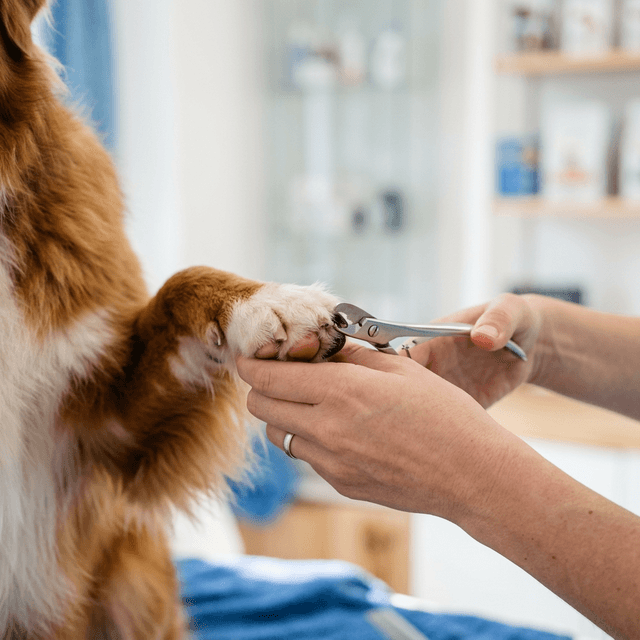
Step 2: Apply direct pressure (1–3 minutes)
Direct pressure is the foundation. Everything else works better once you do this.
- Grab clean gauze or a paper towel.
- Press it firmly against the nail tip.
- Hold steady pressure—don’t keep peeking every 5 seconds.
If you don’t have gauze, a clean cotton pad or a folded tissue works in a pinch. The key is continuous pressure.
Step 3: Use a clotting agent (the fastest “off switch”)
A clotting aid helps form a plug over the quick. Choose one of these:
Best option: Styptic powder (or styptic pencil)
- •Fastest and most reliable for nail quick bleeds.
- •Often used by groomers and vet clinics.
How to use styptic powder:
- Dip a cotton swab into powder (or pour a small amount into the cap).
- Press the powder directly onto the bleeding nail tip.
- Hold pressure for 30–60 seconds.
- Repeat once if needed.
How to use a styptic pencil:
- Moisten the tip slightly.
- Press to the nail tip for 10–20 seconds.
- Reapply if bleeding persists.
Pro-tip: Styptic products can sting briefly. That’s normal—but it’s another reason to hold your dog securely and calmly.
Good backup: Cornstarch or flour
Not as effective as styptic powder, but better than nothing.
- Put a small mound in a shallow dish.
- Press the nail tip into it or pack it onto the nail with a damp cotton swab.
- Apply pressure for 60 seconds.
Avoid using sugar, baking soda mixes, or random DIY “pastes” on an open quick—stick with cornstarch/flour if you’re improvising.
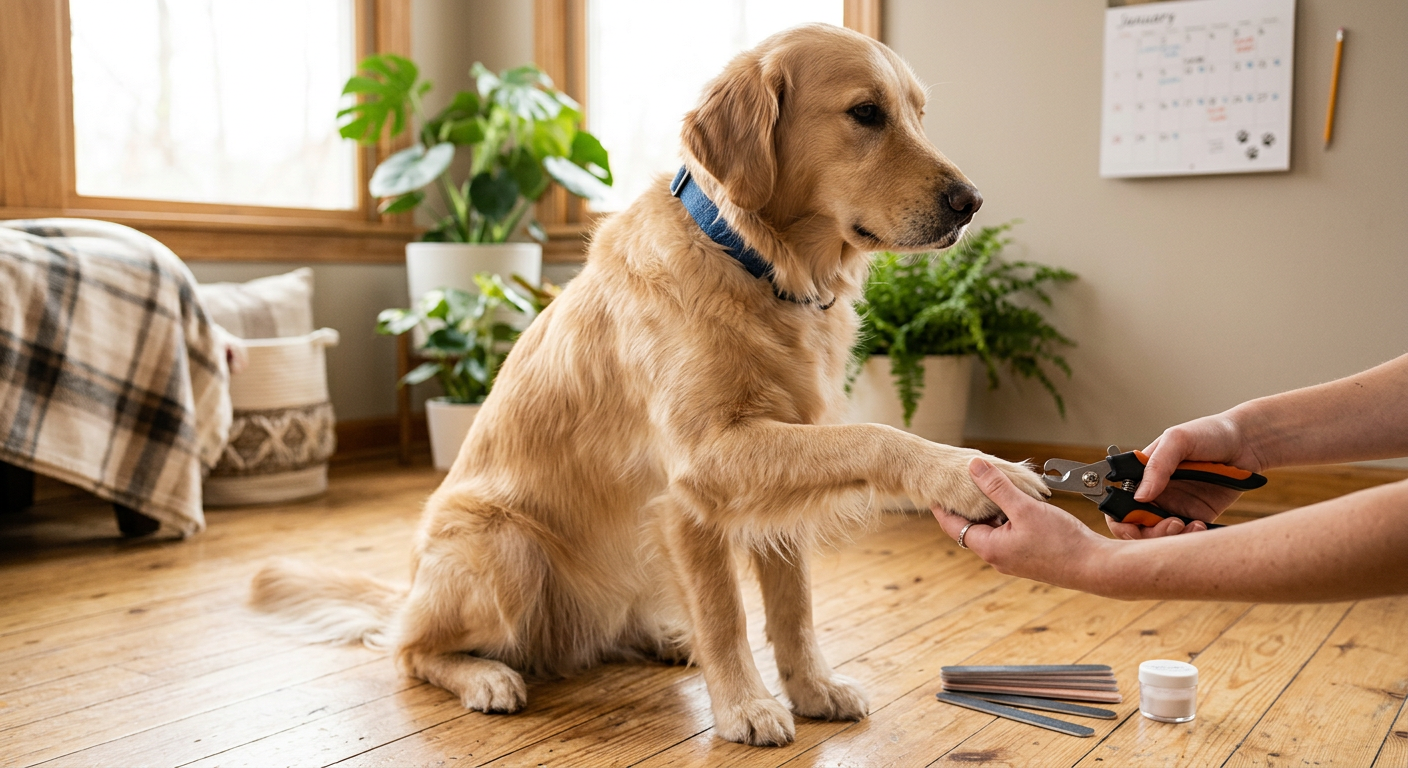
[IMAGE_PLACEHOLDER_1]
Step 4: Check and protect the nail (2 minutes)
Once bleeding stops:
- •Wipe away excess powder gently.
- •Inspect for a split nail or a jagged edge that could re-open.
If the edge is sharp, you can very lightly smooth the tip with a nail file (only if it doesn’t start bleeding again). Do not clip further.
Step 5: Limit activity for a few hours
The clot is fragile at first. For the next 2–4 hours:
- •No running, wrestling, or jumping.
- •Keep your dog off rough outdoor surfaces (gravel can scrape the clot).
- •Avoid licking as much as possible.
If your dog won’t stop licking, use an e-collar (cone) or inflatable collar temporarily.
What to Use: Product Recommendations That Actually Work
You don’t need a full veterinary kit, but a few targeted items make nail trims far less stressful.
Must-have: A styptic product
Top picks (type-based, not brand-dependent):
- •Styptic powder: Best overall for speed and ease.
- •Styptic pencil: Convenient, but can be harder to press firmly on a wiggly dog.
- •Clotting gel (pet-safe): Useful for dogs that hate powder puffing around.
Comparison: Styptic powder vs pencil vs gel
- •Powder: Fastest clotting, easiest to apply with a cotton swab, slightly messy.
- •Pencil: Portable and clean, but requires steady pressure and may be less effective on heavy bleeds.
- •Gel: Cleaner and sometimes less sting, but can take longer and may rub off if the dog walks immediately.
Helpful add-ons for your nail kit
- •Gauze pads: Better than paper towels for firm pressure.
- •Cotton swabs: Precise application of powder.
- •Nail file or grinder: Smoothing reduces re-bleeding.
- •E-collar/inflatable collar: Prevents licking the fresh clot.
- •Treats: High-value (freeze-dried liver, chicken) to reset the mood.
Pro-tip: Keep your styptic product where you trim nails—not buried in a cabinet. Most nail-quick accidents become stressful because people are scrambling while the dog is moving.
Breed Examples: Why Some Dogs Bleed More (Or More Often)
Any dog can have a nail quick nick, but these breed patterns show up constantly in real life.
Black-nailed breeds: “I can’t see where to cut!”
Examples: Labrador Retrievers, Rottweilers, Dobermans, many Pit Bull-type dogs, and lots of mixes.
What helps:
- •Trim tiny slivers at a time.
- •Look for the “bullseye” on the cut surface: as you approach the quick, you’ll see a darker center.
- •Consider a nail grinder to remove small layers gradually.
Tiny breeds: “It’s a small nail but it’s bleeding a lot”
Examples: Chihuahuas, Yorkies, Maltese, Toy Poodles.
What helps:
- •Use small, sharp clippers designed for toy breeds.
- •Support the toe firmly so the nail doesn’t twist.
- •Expect faster bleeding because the nail is small and the quick is proportionally close to the tip.
Sighthounds and thin-skinned dogs: “Bleeding seems dramatic”
Examples: Greyhounds, Whippets.
What helps:
- •Styptic powder is your friend.
- •Handle gently; some have thinner skin and are more sensitive to pressure.
Senior dogs and overgrown nails: “The quick is long”
Examples: Any older dog who’s had infrequent trims; commonly seen in Shih Tzus, Dachshunds, and couch-loving mixes.
What helps:
- •Don’t aim for “short” in one session. Aim for safe.
- •Do frequent micro-trims to encourage the quick to recede over time (more on that later).
Common Mistakes That Keep the Nail Bleeding (And How to Avoid Them)
Most “it won’t stop bleeding!” cases come down to a few fixable errors.
Mistake 1: Wiping and checking too often
Every time you lift pressure, you can pull off the forming clot.
Fix: Apply firm pressure for at least 60 seconds before checking.
Mistake 2: Letting the dog walk around immediately
Hard floors act like sandpaper on the fresh clot.
Fix: Keep your dog still for 10–15 minutes after it stops bleeding, then restrict activity for a few hours.
Mistake 3: Not using enough styptic powder
A dusting isn’t enough for an active quick bleed.
Fix: Pack it onto the nail tip (cotton swab method) and hold pressure.
Mistake 4: Clipping again to “clean it up”
Trimming more often makes it worse.
Fix: Stop cutting. If anything, only file gently once bleeding has stopped.
Mistake 5: Panicking and restraining too aggressively
A scared dog fights harder, and twisting the toe can worsen the injury.
Fix: Calm voice, controlled hold, high-value treats. If your dog is truly frantic, pause and reset.
Pro-tip: If your dog is extremely stressed by nail trims, consider cooperative care training or scheduling trims with a groomer/vet clinic. One calm session beats three traumatic ones.
Real-World First-Aid Scenarios (What I’d Do as a Vet-Tech Friend)
Scenario A: “My dog is shaking his paw and spraying blood on the wall”
This is common, especially with larger dogs.
What to do:
- Leash your dog indoors and bring him to a small room.
- Place a towel under the paw.
- Apply pressure for 1–2 minutes.
- Use styptic powder and pressure for another 60 seconds.
- Keep him calm and still for 10 minutes.
Why it works: Shaking the paw prevents clot formation; leashing stops the chaos.
Scenario B: “My dog won’t let me touch the nail now”
Pain + surprise = refusal.
What to do:
- •Muzzle if needed for safety (basket muzzle is best if your dog is trained to it).
- •Wrap in a towel (small dogs) or have a helper hold and feed treats.
- •Use the cotton swab styptic method; it’s quick and precise.
Safety note: If you think you might get bitten, it’s okay to stop and go to a groomer or vet. A bleeding nail is stressful, but a bite is worse.
Scenario C: “It stopped, but it started bleeding again on the walk”
The clot got rubbed off.
What to do:
- •Go back to pressure + styptic powder.
- •After it stops, keep the paw clean and dry.
- •Consider a short-term bootie or paw wrap for brief potty breaks (not tight; not left on long).
How to Bandage a Bleeding Nail (Without Cutting Off Circulation)
Most minor quick nicks don’t require a bandage, but a simple wrap can protect the clot—especially if your dog keeps licking or you need a quick potty break.
When a bandage helps
- •Your dog is licking obsessively.
- •The nail keeps re-bleeding when walking.
- •You’re heading to the vet and need temporary protection.
Simple, safe bandage steps
- Place a small square of gauze over the nail tip.
- Wrap with a roll gauze or self-adhesive wrap (VetWrap-style) snug, not tight.
- Keep the toes visible if possible so you can monitor swelling.
- Remove within 1–2 hours unless your vet instructs otherwise.
Circulation check (important):
- •Toes should stay warm and normal-colored.
- •If toes swell, feel cold, or your dog suddenly limps more: remove immediately.
Pro-tip: Self-adhesive wrap can tighten as the dog moves. Use fewer layers than you think you need, and don’t leave it on overnight.
[IMAGE_PLACEHOLDER_2]
Aftercare: Prevent Infection and Re-Bleeding Over the Next 48 Hours
Once bleeding stops, your job is to keep the area clean and keep the dog from undoing the clot.
What’s normal after a quick nick
- •Mild tenderness for a day.
- •A tiny amount of dried blood at the tip.
- •Slight hesitation to put full weight briefly.
What’s not normal (call your vet)
- •Increasing redness, swelling, warmth, or discharge.
- •Limping that worsens after 24 hours.
- •Nail splitting further up.
- •Persistent licking that causes raw skin between toes.
Home care tips that help
- •Keep walks short and on smooth surfaces for a day.
- •Wipe the paw after outdoor trips (plain water or pet-safe wipes).
- •Avoid soaking the paw (no long baths) for 24 hours if possible.
Should you use antiseptic?
For a simple quick nick, usually no—the quick is sensitive and you don’t want to irritate it. If the paw got dirty, rinse with clean water and gently pat dry. If you suspect contamination or there’s a tear, consult your vet for appropriate antiseptic use.
Preventing Nail Bleeds Next Time: Trim Smarter, Not Braver
The best fix is not needing first aid.
Choose the right tool for your dog
Clippers
- •Best for: dogs that tolerate handling and have predictable nails.
- •Pros: fast.
- •Cons: easier to accidentally take too much, especially with black nails.
Nail grinders
- •Best for: black nails, thick nails, owners who want more control.
- •Pros: removes tiny layers; easier to “sneak up” on the quick.
- •Cons: noise/vibration training required; can heat the nail if you grind too long.
Step-by-step: Safer trimming technique (works on most dogs)
- Trim after a walk when your dog is calmer.
- Hold the paw firmly but gently; stabilize the toe.
- Take thin slices off the tip rather than one big cut.
- Watch the center of the nail:
- •White nails: stop before the pink quick.
- •Black nails: stop when you see a darker, moist-looking center (“bullseye”).
- Smooth edges with a file/grinder.
How to make the quick recede (the “micro-trim” plan)
If your dog’s nails are long, the quick is long. The safe way to shorten over time:
- •Trim a tiny amount every 5–7 days (or grind briefly).
- •Aim for “just a little” consistently rather than “as short as possible.”
- •In many dogs, you’ll see improvement in 3–6 weeks.
This approach is especially useful for:
- •Senior dogs with long quicks
- •Small dogs that don’t naturally wear nails down indoors
- •Dogs with black nails where visibility is limited
[IMAGE_PLACEHOLDER_3]
FAQs: Quick Answers to Common “Dog Nail Bleeding How to Stop” Questions
How long should a trimmed nail bleed?
With proper pressure and a clotting aid, most stop in 1–5 minutes. If you’re still dealing with active dripping after 20–30 minutes, call a vet.
Is styptic powder safe for dogs?
Yes, when used as directed for minor nail bleeds. Expect brief stinging. Don’t pack large amounts into deep wounds or use on major lacerations—those need veterinary care.
Can I use cornstarch instead of styptic powder?
Yes as a backup. It’s often effective for mild bleeds but can be slower or less reliable than styptic powder.
My dog licked the nail—did he ruin everything?
Maybe. Licking can remove the clot and re-start bleeding. If it starts again, repeat pressure + styptic. Use an e-collar if licking continues.
Should I keep trimming other nails after I hit the quick?
Usually no. Your dog is more likely to struggle after a painful surprise. Stop, end on a positive note (treats), and try again another day.
What if my dog’s nail broke and is bleeding?
A broken nail can expose the quick higher up and is more painful. Apply pressure and styptic if possible, protect with a light bandage, and call your vet—broken nails often need professional trimming/cleanup and pain control.
Quick Checklist: What to Do in the Moment
If you want a simple script to follow:
- Secure your dog (leash, towel, helper).
- Direct pressure with gauze for 60–120 seconds.
- Styptic powder/pencil + pressure for 30–60 seconds.
- Re-check; repeat once if needed.
- Restrict activity for a few hours; prevent licking.
- Call a vet if bleeding persists >20–30 minutes or the nail is torn/split.
If you trim nails regularly, keeping a styptic product and gauze in your grooming kit turns a stressful accident into a quick, controlled fix.
Nail Care Cluster
More in this topic
guide
How to Trim Dog Nails: A Step-by-Step Guide for Beginners
guide
Nail grinder vs clippers for dogs: which is best for your pet?
guide
Dog Nail Trimming at Home: Safe Step-by-Step Routine (Clippers vs Grinders vs Scratch Boards)
guide
How to Trim Dark Dog Nails Without Hitting the Quick (Behavior-First Guide)
guide
How Often Should You Trim Dog Nails? A Practical Schedule by Activity Level
guide
Dog Nail Grinder Training Plan for Nervous Dogs (Diagnostic-First Guide)
Frequently asked questions
What should I do first if my dog's nail is bleeding?
Stay calm and keep your dog still, then apply firm, steady pressure to the tip of the nail with clean gauze or a towel for 5-10 minutes without checking constantly. If available, use styptic powder after pressure to help seal the nail.
What can I use if I don't have styptic powder?
Apply steady pressure first, which is often enough on its own. If bleeding continues, you can use a pet-safe styptic pencil or cornstarch as a temporary option, then keep the paw clean and dry while monitoring for re-bleeding.
When is a bleeding nail an emergency and I should call the vet?
Call your vet if bleeding doesn't slow after 10-15 minutes of continuous pressure, if the nail is cracked/split, or if your dog seems very painful or keeps reopening the wound. Also seek help if your dog has a bleeding disorder, is on blood-thinning medication, or the paw becomes swollen, hot, or oozing.
