

guide • Cat Behavior & Enrichment
Build a cat nighttime zoomies routine that improves sleep fast
Learn why cats get nighttime zoomies and follow a simple play-and-feed schedule that channels energy earlier for quieter nights.
By PetCareLab Editorial • March 5, 2026 • 15 min read
Table of contents
- What “Nighttime Zoomies” Really Are (and Why They Happen)
- Normal vs. “Something’s Off” Zoomies
- Why Your Cat Has Zoomies at Night (Common Triggers)
- 1) Under-stimulated day, over-stimulated night
- 2) Feeding schedule doesn’t match feline biology
- 3) Play that excites but doesn’t “complete the hunt”
- 4) Breed tendencies and personality
- 5) Age matters (a lot)
- The Goal: A Cat Nighttime Zoomies Routine That Protects Sleep
- The Ideal Daily Schedule (with Two Options: Workday vs. WFH)
- Option A: Typical Workday Household
- Option B: Work-From-Home / Flexible Schedule
- Step-by-Step: Build Your Routine in 7 Days (No Guesswork)
- Day 1–2: Baseline and a bedtime anchor
- Day 3–4: Add a morning play + breakfast pairing
- Day 5: Upgrade your play technique (quality > duration)
- Day 6: Add independent enrichment to cover the “boring hours”
- Day 7: Troubleshoot the remaining 20%
- How to Play in a Way That Actually Prevents Night Zoomies
- The 5-Minute “Targeted Burn” Session
- The 15-Minute “Full Hunt” Session (Best Pre-Bed)
- Common Play Mistakes (That Create More Zoomies)
- Feeding Strategy: The Sleep-Friendly Meal Plan
- Best Practice: Split Meals + Use the Bedtime Mini-Meal
- Wet vs. Dry at Night
- Helpful Tools (and When to Use Them)
- Product Recommendations (With Quick Comparisons)
- Interactive Toys (Best for Pre-Bed Play)
- “Catch” and Kicker Toys (Best for Ending Play)
- Puzzle Feeders (Best for Daytime Energy Management)
- Automatic Feeders (Best for “I Wake Humans for Breakfast” Cats)
- Calming Aids (Supportive, Not a Substitute)
- Breed and Household Scenarios (What Changes Based on Your Cat)
- High-Energy Breeds: Bengal, Abyssinian, Savannah Mixes
- Vocal Social Breeds: Siamese, Oriental Shorthair
- Kittens: The “Two Is Easier Than One” Truth
- Multi-Cat Homes: Zoomies + Tension
- Common Mistakes That Keep the Zoomies Going
- 1) Inconsistent timing
- 2) Accidental reinforcement at night
- 3) Underestimating mental enrichment
- 4) Playing too late in an overstimulating way
- 5) Not addressing scratching and climbing needs
- Expert Tips for Better Sleep (Without Fighting Your Cat)
- Use environmental cues to signal bedtime
- Create a “night station” outside your bedroom
- Manage early-morning wakeups strategically
- When to consider a vet or behavior consult
- A Simple “Tonight” Checklist (Put It Into Action Immediately)
What “Nighttime Zoomies” Really Are (and Why They Happen)
If your cat turns into a furry pinball around 10 p.m. to 3 a.m.—sprinting down the hallway, launching off the couch, howling at invisible enemies—you’re seeing a normal behavior pattern with a not-so-fun timing problem.
Nighttime zoomies are bursts of high-energy activity that often show up after the household settles down. In many cats, it’s a mix of:
- •Crepuscular instincts: Cats are naturally most active at dawn and dusk. Indoor life and human schedules can shift that activity later.
- •Stored energy: If a cat naps most of the day (especially in a quiet home), energy stacks up and spills out at night.
- •Predatory sequence unmet: Cats feel best when they can “hunt → catch → kill → eat → groom → sleep.” If play doesn’t mimic that cycle, they may keep revving.
- •Attention learning: If zoomies lead to you getting up, talking, chasing, or feeding, your cat may learn, “Night is when humans respond.”
- •Environment and routine gaps: Not enough vertical space, not enough novelty, feeding schedule mismatch, or boredom—all amplify late-night chaos.
For this article, we’re focusing on building a cat nighttime zoomies routine—a repeatable play + feeding + wind-down schedule that meets your cat’s biology and protects your sleep.
Normal vs. “Something’s Off” Zoomies
Zoomies themselves are not a diagnosis. They’re a symptom of energy and arousal. But it’s important to separate “healthy silly” from “call the vet.”
Usually normal:
- •Short bursts (30 seconds to a few minutes) followed by settling
- •Playful body language: ears forward, loose tail, bouncy movement
- •Happens after naps or during predictable times (dusk/night)
Get a vet check if you notice:
- •Sudden increase in nighttime agitation in an older cat
- •Vocalizing that sounds distressed (not just “I’m bored” yowls)
- •Litter box issues, increased thirst/urination, weight change
- •Overgrooming, skin twitching, or frantic biting at the back/tail
- •Pain signs: reluctance to jump, hiding, growling when touched
As a vet-tech-style rule of thumb: if the pattern is new, intense, and persistent—rule out medical causes before assuming it’s purely behavioral.
Why Your Cat Has Zoomies at Night (Common Triggers)
Understanding the trigger helps you pick the right fix. Most cats don’t need “more play” in general—they need the right play at the right time.
1) Under-stimulated day, over-stimulated night
Cats in quiet homes often sleep deeply when nothing happens. Then at night, the home finally feels interesting: shadows, headlights, nocturnal outdoor critters, HVAC clicks, and your attention.
Real-world scenario:
- •You work 9–6, your cat sleeps.
- •You cook dinner, watch TV, and your cat naps again.
- •At 11 p.m., you go to bed and suddenly your cat is wide awake and furious about it.
2) Feeding schedule doesn’t match feline biology
If your cat gets a big meal early, then nothing for hours, hunger can trigger activity and food-seeking zoomies.
If your cat wakes you at 3 a.m. like an alarm clock with claws, you’re likely dealing with learned reinforcement plus hunger.
3) Play that excites but doesn’t “complete the hunt”
Laser pointers can be fun, but if there’s no “catch,” some cats stay amped and frustrated—hello, midnight chaos.
Better: end with a toy they can bite/kick and “win,” then feed a small meal.
4) Breed tendencies and personality
Some breeds and mixes are built for intensity.
Examples:
- •Bengals: high-drive, athletic, needs daily structured hunting play and climbing outlets.
- •Abyssinians: busy, curious, thrives on training games and novelty.
- •Siamese/Oriental types: social, vocal, often need interactive time and predictable routine.
- •Maine Coons: playful and smart; many enjoy longer sessions but may prefer “stalk and pounce” to frantic sprints.
- •Domestic shorthairs: vary widely; many respond dramatically to routine tweaks.
5) Age matters (a lot)
- •Kittens (under 1 year): Expect zoomies. Your job is to channel them, not erase them.
- •Young adults (1–6 years): Prime zoomies era, especially indoor-only cats.
- •Seniors (10+ years): New nighttime restlessness can be pain, thyroid disease, cognitive changes, or sensory decline.
The Goal: A Cat Nighttime Zoomies Routine That Protects Sleep
The best routines do three things:
- Drain energy in a way that feels satisfying (not just exhausting).
- Predictably meet needs (food, play, social time) so your cat doesn’t have to create a crisis.
- Teach a wind-down cue so bedtime becomes a pattern your cat can anticipate.
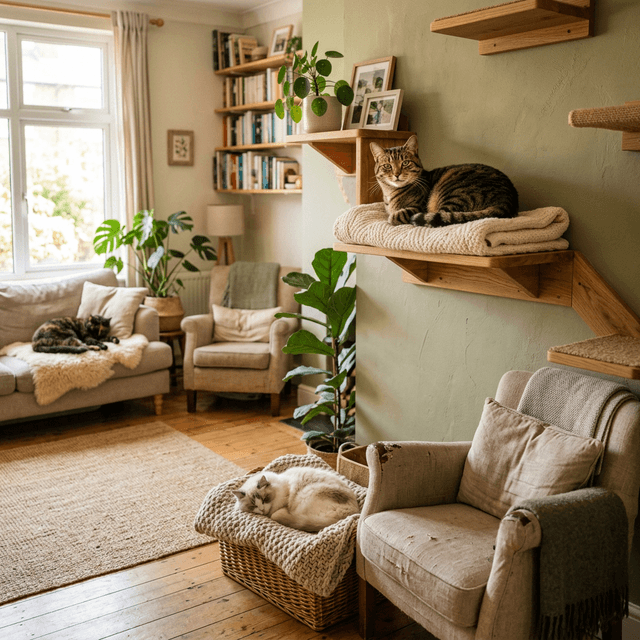
Think: you’re not “stopping zoomies.” You’re moving the energy earlier and finishing the predatory cycle so your cat’s nervous system actually powers down.
[IMAGE_PLACEHOLDER_1]
The Ideal Daily Schedule (with Two Options: Workday vs. WFH)
Below are two schedules you can adapt. Your exact times don’t matter as much as consistency.
Option A: Typical Workday Household
Morning (10–15 minutes)
- •5–8 minutes of interactive play (wand toy, stalk/pounce)
- •Small breakfast (or puzzle feeder portion)
- •1–2 minutes of calm affection or grooming (if your cat likes it)
After work / early evening (15–25 minutes)
- •Short play session (use a different toy type than morning)
- •Enrichment reset: rotate 1–2 toys, refresh window perch, add a cardboard box
Pre-bed “Hunt → Eat → Groom → Sleep” block (25–40 minutes total)
- 10–15 minutes interactive hunting play
- 2–5 minutes “catch” play (kicker toy, plush prey)
- Small meal (wet food works great here)
- Quiet time (lights dim, calm voice, no rough play)
- Optional: treat scatter in a snuffle mat for decompression
Option B: Work-From-Home / Flexible Schedule
You have a secret weapon: micro-sessions.
- •3–5 mini play sessions (3–7 minutes each) spaced out
- •Meals split into smaller portions
- •One longer pre-bed “hunt-eat” block
This tends to produce the biggest sleep improvement because your cat doesn’t spend 8 hours bankrolling energy.
Step-by-Step: Build Your Routine in 7 Days (No Guesswork)
The fastest way to see change is to treat this like a short behavior program. Don’t overhaul everything at once—tweak, observe, adjust.
Day 1–2: Baseline and a bedtime anchor
- Pick a consistent bedtime and wake time for you.
- Add a 10–15 minute pre-bed play session (same time both nights).
- Immediately after play, offer a small meal.
- When you go to bed, keep interactions boring (more on that later).
What to log:
- •Zoomies start time
- •How long they last
- •What your cat did (running, vocalizing, toy play, scratching)
Day 3–4: Add a morning play + breakfast pairing
- Add 5–8 minutes of play shortly after you wake up.
- Feed breakfast right after.
- If your cat demands food early, delay breakfast by 5 minutes each morning until it matches your ideal wake time.
Why this works:
- •You’re teaching, “Morning is for action and food,” which reduces the drive to create drama at night.
Day 5: Upgrade your play technique (quality > duration)
Use the predatory sequence on purpose:
- •Stalk: move the toy slowly behind furniture edges
- •Chase: quick bursts away from your cat
- •Pounce: let them catch it regularly (every 30–90 seconds)
- •Kill bite + bunny kicks: switch to a kicker toy at the end
- •Eat: small meal to close the loop
Day 6: Add independent enrichment to cover the “boring hours”
Pick 2–3:
- •Puzzle feeder for one meal portion
- •Window perch + bird feeder outside (if possible)
- •Rotating toy basket (only 5–7 toys out at once)
- •Cardboard box “tunnels” and paper bags (handles removed)
- •Cat-safe grass planter
- •Vertical space: a tall cat tree near a window
Day 7: Troubleshoot the remaining 20%
Most cats improve a lot by now, but if the zoomies persist:
- •Increase play intensity (more sprints, more climbs)
- •Split dinner into two smaller servings (one early evening, one post-play)
- •Reduce nighttime reinforcement (no feeding “to make it stop”)
If your cat is a high-drive breed (Bengal, Abyssinian) or a single kitten, you may need two solid interactive sessions daily long-term.
How to Play in a Way That Actually Prevents Night Zoomies
A huge reason routines fail is that play becomes either too gentle (cat stays energized) or too chaotic (cat gets overstimulated). Aim for “satisfying predator,” not “caffeine toddler.”
The 5-Minute “Targeted Burn” Session
Perfect when you’re short on time.
- Start with low, slow movements (10–20 seconds)
- Trigger 2–3 short chases (5–10 seconds each)
- Let your cat catch the toy (10 seconds)
- Repeat 3–4 cycles
- End with a kicker toy “win,” then a small treat
The 15-Minute “Full Hunt” Session (Best Pre-Bed)
- Warm-up (3 min): slow stalk, hide-and-peek behind corners
- Sprint rounds (6–8 min): fast darts, up/down a cat tree, across a rug runway
- Catch cycles (2–3 min): frequent wins, tug lightly
- Kill toy finish (2 min): kicker toy or plush prey
- Meal immediately after
Pro tip: If your cat starts panting (especially flat-faced breeds like Persians/Exotics), slow down and add rest breaks. Cats can overheat quickly during intense indoor play.
Common Play Mistakes (That Create More Zoomies)
- •Only using a laser pointer without a physical catch at the end
- •Playing right on the bed (teaches: bed = playground)
- •Overly long sessions that wind your cat up instead of satisfying them
- •Stopping play when your cat is “finally interested” (end on a win, not mid-hunt)
- •Using hands/feet as toys (creates nighttime ankle attacks)
Feeding Strategy: The Sleep-Friendly Meal Plan
Food is one of the strongest levers you have. Cats are built to hunt small prey meals repeatedly. One or two big meals can leave them restless at odd hours.
Best Practice: Split Meals + Use the Bedtime Mini-Meal
If your vet has cleared your cat’s calorie needs, try:
- •Breakfast
- •Dinner (smaller portion)
- •Post-play bedtime snack (smallest portion)
That bedtime snack is not “spoiling.” It’s biology: after a successful hunt, cats naturally eat and sleep.
Wet vs. Dry at Night
- •Wet food often works better before bed: higher moisture, tends to be more satiating per volume, and aligns with a “fresh prey” feel.
- •Dry food can still work—especially in a timed feeder—but cats may snack and stay semi-awake.
Helpful Tools (and When to Use Them)
- •Automatic feeder: Great for cats who wake you for food. Set a tiny early-morning portion so the machine becomes the food source, not you.
- •Puzzle feeders / treat balls: Best during the day or early evening; avoid super noisy ones at night if you’re a light sleeper.
- •Lick mats (cat-safe): Helpful for calming; use a thin smear of wet food or puree.
Pro tip: If your cat wakes you at 4 a.m. and you feed them, you are training a very efficient habit. Instead, use an automatic feeder or shift calories to bedtime.
Product Recommendations (With Quick Comparisons)
You don’t need a room full of gadgets, but the right tools make your cat nighttime zoomies routine easier to maintain.
[IMAGE_PLACEHOLDER_2]
Interactive Toys (Best for Pre-Bed Play)
Wand toys (top pick)
- •Why: mimic prey movement and let you control intensity
- •Look for: durable line, replaceable attachments, long wand for distance
- •Best for: Bengals, Abyssinians, young adults, most cats
Pros: high engagement, completes hunt cycle Cons: requires your participation
“Catch” and Kicker Toys (Best for Ending Play)
- •Kicker toys filled with catnip/silvervine (if your cat responds)
- •Plush prey with crinkle or rattle
Pros: gives a satisfying “kill” outlet Cons: some cats ignore them without training (start by rubbing wand lure on it)
Puzzle Feeders (Best for Daytime Energy Management)
- •Simple rolling treat balls
- •Stationary puzzle boards
- •Snuffle mats (cat-sized, tight weave)
Pros: mental work reduces boredom energy Cons: can frustrate some cats; start easy and increase difficulty
Automatic Feeders (Best for “I Wake Humans for Breakfast” Cats)
- •Choose one with reliable portion control and easy cleaning
- •If feeding wet food: consider models with ice packs or only use for daytime
Pros: breaks the “human = food at night” loop Cons: not ideal for multi-cat households unless cats are separated
Calming Aids (Supportive, Not a Substitute)
- •Pheromone diffusers/sprays: helpful for some cats, especially in multi-cat tension
- •Comfortable bedding in a quiet zone: helps reinforce the wind-down phase
Important: If you’re considering supplements, especially for kittens, seniors, or cats on meds, check with your vet first.
Breed and Household Scenarios (What Changes Based on Your Cat)
High-Energy Breeds: Bengal, Abyssinian, Savannah Mixes
These cats often need:
- •Two structured play sessions daily (morning + pre-bed)
- •Vertical climbing and jump paths
- •Training games (sit, target touch, “go to mat”) for mental fatigue
Real-world scenario:
- •A Bengal does 15 minutes of wand play… then sprints anyway.
Fix:
- •Add climbing sprints (up/down a tall tree), end with a kicker win, and split dinner so the bedtime snack is meaningful.
Vocal Social Breeds: Siamese, Oriental Shorthair
Often, the “zoomies” are part energy, part social needs.
- •Add predictable social time earlier in the evening
- •Try a short training session before bed (2–3 minutes)
- •Ensure they have an acceptable nighttime activity (solo toy, puzzle earlier, window perch)
Kittens: The “Two Is Easier Than One” Truth
Single kittens often create relentless night zoomies because you’re the only playmate.
- •If adding a second kitten is feasible, it can dramatically reduce human sleep disruption.
- •If not: increase interactive play frequency and provide safe solo outlets.
Multi-Cat Homes: Zoomies + Tension
Sometimes the nighttime chaos is triggered by:
- •competition for resources (food stations, litter boxes, sleeping spots)
- •ambush points in hallways
Fixes:
- •Add multiple feeding stations
- •Increase litter boxes (a common guideline is one per cat + one extra)
- •Create two vertical routes so cats can pass without conflict
[IMAGE_PLACEHOLDER_3]
Common Mistakes That Keep the Zoomies Going
If you’ve “tried everything” but nothing sticks, one of these is usually the culprit.
1) Inconsistent timing
Cats love patterns. If bedtime play happens sometimes, your cat may stay alert waiting to see what tonight brings.
Aim for: play + snack within the same 30–60 minute window nightly.
2) Accidental reinforcement at night
These responses often make zoomies stronger:
- •Getting up and chasing the cat out
- •Talking, scolding, laughing (attention is attention)
- •Feeding to stop the behavior
Instead:
- •Keep your reaction boring and brief
- •If needed, calmly close the bedroom door (with enrichment available outside)
3) Underestimating mental enrichment
A cat can be physically tired and still wired if their brain is bored.
Add:
- •short clicker training
- •food puzzles
- •scent games (treats hidden in paper cups)
4) Playing too late in an overstimulating way
If play is extremely intense right as lights go out, some cats stay in “hunt mode.”
Fix:
- •End the main play 20–30 minutes before lights-out
- •Use the snack and quiet time as a buffer
5) Not addressing scratching and climbing needs
A cat with no acceptable place to sprint, climb, and scratch will invent one—often your bed.
Minimum setup:
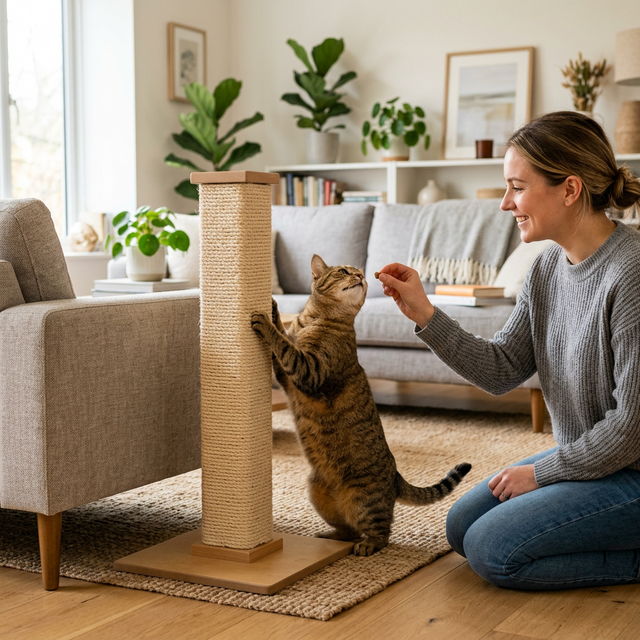
- •one tall scratcher or cat tree
- •one horizontal scratcher
- •one high perch or shelf
Expert Tips for Better Sleep (Without Fighting Your Cat)
These are small adjustments that make the routine easier to maintain.
Pro tip: Put your cat’s “best” toy away and only bring it out for pre-bed play. Scarcity makes it more exciting and increases your success without adding time.
Use environmental cues to signal bedtime
- •Dim lights in the evening
- •Turn on a consistent sound (fan/white noise)
- •Keep a predictable final sequence: play → snack → brush → bed
Create a “night station” outside your bedroom
Set up:
- •water
- •litter access
- •a cozy bed
- •a safe chew/kicker toy
- •optional: timed feeder for early morning
Manage early-morning wakeups strategically
If your cat wakes you for breakfast:
- Stop feeding immediately upon waking (even once in a while keeps it alive)
- Use an automatic feeder to deliver the first meal
- Slowly shift that feeder time later (5 minutes every few days)
When to consider a vet or behavior consult
If you’ve done a consistent routine for 2–3 weeks and still see:
- •extreme nighttime agitation
- •aggression or persistent conflict with other pets
- •signs of anxiety or compulsive behavior
A vet can rule out medical causes and discuss safe behavior supports.
A Simple “Tonight” Checklist (Put It Into Action Immediately)
If you want a practical starting point you can do tonight:
- 15 minutes of wand play that includes frequent catches
- 2 minutes with a kicker toy “win”
- Small wet-food snack right after
- Lights dim + quiet for 15–20 minutes
- No rewarding wakeups (use a feeder if needed)
Do that consistently for a week and most households see a major reduction in nighttime chaos—because you’re working with your cat’s instincts instead of arguing with them.
If you tell me your cat’s age, breed (or best guess), feeding schedule, and when the zoomies usually start, I can help you fine-tune a cat nighttime zoomies routine that fits your exact household.
Topic Cluster
More in this topic
Frequently asked questions
Why does my cat get zoomies at night?
Nighttime zoomies are often a normal burst of energy tied to a cat's crepuscular instincts, meaning they naturally feel most active at dusk and dawn. If the evening is quiet or your cat didn't get enough play during the day, that energy can peak right when you want to sleep.
What is the best cat nighttime zoomies routine to improve sleep?
Aim for a predictable evening sequence: active play that mimics hunting (stalk-chase-pounce) followed by a small meal, then a calm wind-down. This helps satisfy the hunt-eat-rest cycle and shifts your cat's activity earlier, making late-night sprints less likely.
How long should I play with my cat before bed to reduce zoomies?
Most cats do well with 10-20 minutes of focused, high-intensity play in the evening, sometimes split into two short sessions. End on a few successful "catches," then offer food and quiet time so your cat settles instead of staying revved up.
