
guide • Cat Behavior & Enrichment
Stop Cat Scratching Sofa Without Punishment: Redirect That Works
Scratching is normal. Use a punishment-free redirect system with the right scratchers, placement, and rewards to protect your sofa and reduce stress.
By PetCareLab Editorial • March 5, 2026 • 14 min read
Table of contents
- Why Cats Scratch the Sofa (And Why Punishment Backfires)
- The problem with punishment (even “mild” punishment)
- The Redirect System: What You’re Building (In Plain English)
- The simple rule that makes this work
- Step 1: Identify Your Cat’s “Scratch Profile” (So You Buy the Right Stuff)
- A) Scratching orientation: vertical, horizontal, or both?
- B) Material preference: what texture is your cat “voting” for?
- C) Location preference: where is the scratch “message board”?
- Breed and personality notes (helpful, not absolute)
- Step 2: Set Up “Legal Scratch Zones” Where Your Cat Already Scratches
- Placement rule: “One scratcher per problem area—at first”
- What “good” looks like in a scratcher (minimum specs)
- Step 3: Make the Sofa Unappealing (Without Scaring Your Cat)
- Best sofa-protection options (what I recommend in real homes)
- Option 1: Clear furniture guards (plastic sheets or corner protectors)
- Option 2: Double-sided tape (cat-specific or furniture-safe)
- Option 3: Slipcovers or tightly tucked throws (strategic)
- Option 4: Texture blockers (foil or crinkly mats) — short-term only
- Scent reset: clean the scratched areas properly
- What I don’t recommend
- Step 4: Teach “Scratch Here” With Rewards (The Part Most People Skip)
- The timing rule (this matters more than the treat brand)
- A step-by-step training routine (5 minutes, 2–3 times daily)
- How to “introduce” a scratcher without forcing
- Step 5: Redirection Scripts That Don’t Feel Like Punishment
- The calm redirect (best all-purpose approach)
- The “block and swap” method (for cats who scratch when you’re on the couch)
- Redirecting in multi-cat homes
- Step 6: Choose Products That Actually Work (With Comparisons)
- Best scratcher types for sofa scratchers
- Tall sisal post (the “sofa replacement” workhorse)
- Sisal wall-mounted scratcher (for precision problem spots)
- Cardboard lounger scratcher (horizontal + rest spot)
- Cat tree with integrated sisal (best for high-energy breeds)
- Sofa protection product recommendations (what to buy and why)
- Step 7: Nail Care and Alternatives (Helpful, Not a Substitute)
- Nail trimming: a realistic, low-stress routine
- Soft nail caps (when they make sense)
- What about declawing?
- Step 8: Common Mistakes That Keep the Sofa the “Best Option”
- Troubleshooting: If Your Cat Still Scratches the Sofa
- “My cat ignores the scratcher completely.”
- “My cat scratches the scratcher… and the sofa.”
- “My cat scratches when we have company / loud noises / schedule changes.”
- “It started suddenly in an adult cat.”
- A 14-Day Sofa-Saving Plan (Simple and Realistic)
- Days 1–3: Set up and protect
- Days 4–7: Build the habit
- Days 8–14: Increase reliability
- Quick FAQ: Practical Questions Cat Parents Ask
- Should I spray repellents on the couch?
- How many scratchers do I really need?
- Can I train an older cat?
- What if my cat scratches the sofa while maintaining eye contact?
- The Takeaway: A Sofa-Friendly Home That Still Lets Your Cat Be a Cat
Why Cats Scratch the Sofa (And Why Punishment Backfires)
Scratching isn’t “bad behavior.” It’s a normal, hardwired cat need that serves several purposes at once:
- •Nail maintenance: Scratching helps shed old claw sheaths.
- •Muscle and joint health: It’s a full-body stretch for shoulders, back, and toes.
- •Communication: Cats leave visual marks and scent from glands in their paws.
- •Stress relief: Many cats scratch more when they’re anxious, bored, or overstimulated.
So why the sofa? Because it’s often the best scratching surface in the room: tall enough for a full stretch, stable, textured, and positioned in a high-traffic “message board” area.
The problem with punishment (even “mild” punishment)
If your goal is to stop cat scratching sofa without punishment, you’re on the right track. Here’s why punishment (yelling, spray bottles, clapping, “no!”) typically fails long-term:
- •It teaches fear, not a better option. The cat learns “human = unpredictable,” not “scratch this instead.”
- •It increases stress, which can increase scratching (and other issues like urine marking).
- •It’s inconsistent. You won’t always be there. The sofa is.
- •It can damage your bond, especially with sensitive breeds and individuals.
Real-world example: A skittish rescue domestic shorthair scratches the couch when the family is busy. A spray bottle makes her bolt and hide… but she scratches again at night when no one is watching. The scratching never truly stops—it just moves to “when it’s safe.”
The solution is a system: redirect + reward + make the sofa boring.
[IMAGE_PLACEHOLDER_1]
The Redirect System: What You’re Building (In Plain English)
Think of this as a three-part behavior plan:
- Provide a better scratching option (strategic placement + correct type of scratcher).
- Make the sofa less rewarding (temporary protection + texture change + scent reset).
- Reinforce the right choice (timing + treats + praise + play).
This works because cats repeat what pays off. Your job is to make scratching the scratcher pay better than scratching the sofa—without intimidation, without battles.
The simple rule that makes this work
Don’t try to “stop scratching.” Try to “move scratching.” Your cat needs to scratch daily. If you remove the outlet, the sofa (or carpet, or doorframes) will volunteer.
Step 1: Identify Your Cat’s “Scratch Profile” (So You Buy the Right Stuff)
Before you buy anything, spend 2 days observing:
A) Scratching orientation: vertical, horizontal, or both?
- •Vertical scratchers: Cats who scratch sofa arms, chair backs, doorframes
Common in: Maine Coon, Norwegian Forest Cat, long-bodied cats who love full stretches
- •Horizontal scratchers: Cats who go for rugs, carpet edges, flat upholstery
Common in: British Shorthair, some seniors, cats with mild arthritis
- •Both: Many cats want variety
B) Material preference: what texture is your cat “voting” for?
Your sofa’s fabric is giving you clues:
- •Tight weave/linen-like = try sisal fabric or high-quality sisal rope
- •Velvet/microfiber = try corrugated cardboard or carpet-style scratchers (use carefully; see mistakes section)
- •Leather = often about location and height, not texture—provide a tall stable post close by
C) Location preference: where is the scratch “message board”?
Cats often scratch:
- •Near entrances (front door, hallway)
- •Near sleeping areas
- •Near social hubs (living room, where you sit)
If your cat scratches the sofa where you lounge, it’s not spite. It’s a prime billboard.
Breed and personality notes (helpful, not absolute)
- •Siamese / Oriental Shorthair: highly social, easily bored—needs more interactive play + scratch variety.
- •Bengal / Abyssinian: athletic—needs very tall, very stable scratch options and climbing routes.
- •Ragdoll: often gentle but still scratches—may prefer sturdy vertical scratchers and plush/wood bases.
- •Persian / Exotic Shorthair: may prefer lower scratchers; watch for coat snagging on cheap sisal.
Step 2: Set Up “Legal Scratch Zones” Where Your Cat Already Scratches
This is where most well-meaning cat parents go wrong: they buy a scratcher and place it in a corner far from the action. Then the cat keeps scratching the sofa… because the sofa is in the right spot.
Placement rule: “One scratcher per problem area—at first”
For the first 2–4 weeks:
- •Put a scratcher within 6–12 inches of the scratched sofa spot (yes, that close).
- •If the sofa has multiple scratched areas, cover the favorite one first and place the scratcher beside it.
What “good” looks like in a scratcher (minimum specs)
For vertical scratching posts:
- •Height: at least 28–32 inches (taller for big cats: 34–36+ inches)
- •Stability: should not wobble when your cat launches into it
- •Surface: sisal (rope or fabric) is usually the best “sofa alternative”
For horizontal scratchers:
- •Long enough for a full-body stretch
- •Doesn’t slide (use rug grippers or a weighted base)
- •Replaceable inserts (cardboard scratchers wear out quickly)
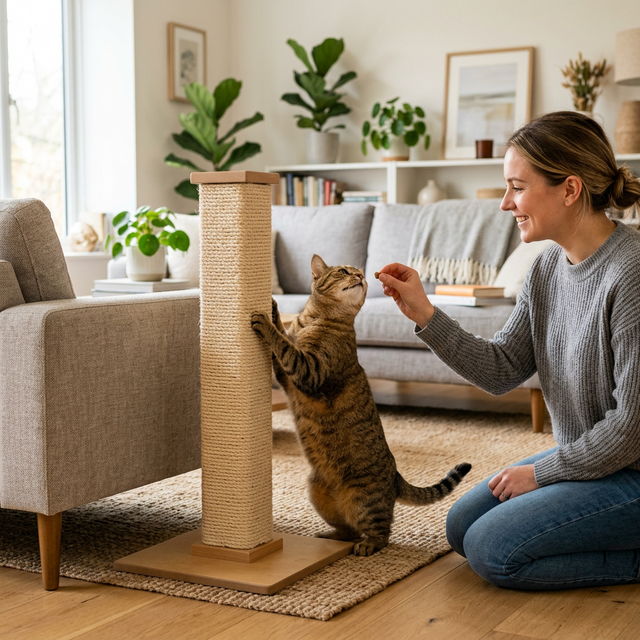
Pro-tip: If your cat scratches the very corner of the sofa, place a vertical scratcher so the cat can scratch the post while standing in the exact same spot they used for the sofa. You’re not changing their routine—just swapping the surface.
[IMAGE_PLACEHOLDER_2]
Step 3: Make the Sofa Unappealing (Without Scaring Your Cat)
Your goal is not to punish; it’s to remove the “reward” of that texture and angle. These are temporary training wheels until the habit transfers.
Best sofa-protection options (what I recommend in real homes)
Option 1: Clear furniture guards (plastic sheets or corner protectors)
- •Works well for: persistent scratchers, kittens, multi-cat homes
- •Pros: immediate results, durable, unobtrusive from a distance
- •Cons: some adhesives can leave residue; follow directions carefully
Option 2: Double-sided tape (cat-specific or furniture-safe)
- •Works well for: cats who dislike sticky textures
- •Pros: affordable, flexible, easy to apply
- •Cons: can attract dust/hair; not ideal for delicate fabrics
Option 3: Slipcovers or tightly tucked throws (strategic)
- •Works well for: renters, frequent guests, protecting large areas
- •Pros: fast coverage, washable
- •Cons: doesn’t teach by itself—must pair with scratchers + rewards
Option 4: Texture blockers (foil or crinkly mats) — short-term only
- •Works well for: quick interruption during training
- •Pros: easy, cheap
- •Cons: some cats find it fun; not the prettiest solution
Scent reset: clean the scratched areas properly
Cats are attracted back to “marked” places. Clean the scratched area to reduce scent cues:
- •Use an enzymatic cleaner labeled for pet odors (even if you don’t smell anything).
- •Let it fully dry.
- •Avoid ammonia-based cleaners (smells like urine to cats).
What I don’t recommend
- •Citrus essential oils on furniture (many essential oils are unsafe for cats).
- •Punishment devices that startle (air puff alarms, shock mats). They can create anxiety and backfire.
Step 4: Teach “Scratch Here” With Rewards (The Part Most People Skip)
Now that you’ve made the sofa less satisfying, you need to make the scratcher highly rewarding.
The timing rule (this matters more than the treat brand)
Reward within 1–2 seconds of your cat using the scratcher. That’s how your cat connects: “I scratched this thing, good stuff happens.”
A step-by-step training routine (5 minutes, 2–3 times daily)
- Set the stage: Put the scratcher next to the sofa scratch zone.
- Load your rewards: small, high-value treats (pea-sized), or a favorite toy.
- Catch the behavior:
- •If your cat naturally scratches the scratcher: mark and reward immediately.
- •If your cat approaches the sofa: calmly redirect (see next section).
- Reinforce: treat + gentle praise + a short play burst (10–20 seconds).
- Repeat: end on a success.
How to “introduce” a scratcher without forcing
- •Sprinkle a small pinch of catnip (for cats that respond to it; about 50–70% do).
- •Use silvervine for cats who ignore catnip (often more effective).
- •Drag a wand toy so your cat “hunts” near the scratcher and then naturally grabs it.
- •Reward any interaction at first: sniffing, pawing, even standing next to it.
Pro-tip: For kittens and high-energy breeds (Bengals, Abyssinians), pair scratching with play. Many will scratch right after an adrenaline burst—your job is to make sure the scratcher is the nearest “landing pad.”
Step 5: Redirection Scripts That Don’t Feel Like Punishment
When your cat goes for the sofa, what you do in the next 3 seconds matters.
The calm redirect (best all-purpose approach)
- Approach quietly (no shouting).
- Interrupt without threat: a soft “psst” or gentle clap once (not loud).
- Guide to the scratcher: lure with a treat or toy.
- Reward scratching the scratcher immediately.
You’re not “scolding.” You’re doing a quick detour.
The “block and swap” method (for cats who scratch when you’re on the couch)
Scenario: Your cat scratches the sofa arm while staring at you (classic attention scratch).
Do this:
- •Place a vertical scratcher at the sofa arm.
- •When scratching starts, calmly place your hand or a pillow between cat and sofa without pushing the cat.
- •Immediately lure to the post and reward.
This works especially well for smart, social cats like Siamese, who quickly learn: “Scratching this gets my person’s attention and treats.”
Redirecting in multi-cat homes
If you have multiple cats, sofa scratching can be partly territorial.
- •Add more scratch stations: at least one per cat, plus one extra.
- •Spread scratchers across key areas so one cat can’t “guard” the only post.
- •Reward each cat separately so the shy one doesn’t lose out.
Step 6: Choose Products That Actually Work (With Comparisons)
You don’t need a room full of cat furniture—but you do need the right types.
Best scratcher types for sofa scratchers
Tall sisal post (the “sofa replacement” workhorse)
Best for: cats scratching sofa arms/backs Look for:
- •wide, heavy base
- •30+ inch height
- •thick sisal wrap or sisal fabric panels
Why it works: it matches the vertical stretch + resistance your sofa provides.
Sisal wall-mounted scratcher (for precision problem spots)
Best for: cats who scratch one specific corner repeatedly Look for:
- •secure mounting into studs or with strong anchors
- •vertical orientation near the scratched zone
Why it works: some cats prefer the firmness of a fixed surface.
Cardboard lounger scratcher (horizontal + rest spot)
Best for: carpet scratchers or cats who like flat upholstery Look for:
- •dense cardboard (lasts longer)
- •reversible insert
Why it works: scratching + lounging becomes a habit loop.
Cat tree with integrated sisal (best for high-energy breeds)
Best for: Bengals, young cats, multi-cat households Look for:
- •stability (no wobble)
- •multiple scratch surfaces at different heights
Why it works: scratching is part of a larger enrichment “route.”
Sofa protection product recommendations (what to buy and why)
- •Clear furniture corner guards: best if you need the sofa protected today while training catches up.
- •Furniture-safe double-sided tape: great for fabric sofas and for “training zones” you’ll remove later.
- •Enzymatic cleaner: reduces repeat scratching triggered by scent.
If you want to keep it simple, your starter kit is:
- One tall sisal post
- One horizontal scratcher
- One sofa protection method (guards or tape)
- High-value treats
Step 7: Nail Care and Alternatives (Helpful, Not a Substitute)
Scratching is normal even with perfect nail trims. But nail care can reduce damage while you retrain.
Nail trimming: a realistic, low-stress routine
- •Trim every 2–4 weeks (kittens more often).
- •Aim for the sharp tip only—avoid the pink quick.
- •Pair with treats and stop early if your cat is stressed.
Real-world scenario: A senior British Shorthair with mild arthritis may scratch less but has thicker nails that snag. Regular tiny trims prevent “hooking” into upholstery.
Soft nail caps (when they make sense)
Nail caps can help protect furniture in certain situations:
- •temporary solution during training
- •households with fragile upholstery
- •cats who tolerate handling well
But:
- •they require proper application and maintenance
- •they don’t replace enrichment and scratch training
- •some cats hate the feeling and will chew them off
What about declawing?
Declawing is an amputation of the last bone of each toe. It’s associated with pain and behavior issues (including biting and litter box problems). A redirect system is the humane, modern alternative.
[IMAGE_PLACEHOLDER_3]
Step 8: Common Mistakes That Keep the Sofa the “Best Option”
These are the pitfalls I see most often:
- •Buying a short, wobbly post: if it tips even once, many cats won’t trust it again.
- •Putting the scratcher in a low-traffic corner: cats scratch where they live, not where you store cat items.
- •Using catnip as the only strategy: it’s a bonus, not the training plan.
- •Removing the sofa protection too early: keep it up until the scratcher habit is consistent.
- •Accidentally rewarding sofa scratching: pushing the cat, talking loudly, chasing—attention can reinforce the behavior (especially in social breeds).
- •Not replacing worn-out scratchers: once the scratcher is “used up,” the sofa looks appealing again.
Pro-tip: If your cat scratches right after waking up, put a scratcher near their favorite nap spot. Morning stretching is one of the easiest habits to redirect because it happens predictably.
Troubleshooting: If Your Cat Still Scratches the Sofa
If you’ve tried the basics and the scratching persists, use this checklist.
“My cat ignores the scratcher completely.”
Try:
- •different orientation (vertical vs horizontal)
- •different material (sisal vs cardboard vs wood)
- •different placement (move it closer to the sofa, then gradually away)
- •adding movement: wand toy play near the scratcher
- •rewarding tiny steps (sniff, touch, one paw = treat)
“My cat scratches the scratcher… and the sofa.”
That’s normal at first. Do:
- •keep sofa guards/tape in place
- •add a second scratcher on the other side of the sofa (cats like options)
- •increase reinforcement for scratcher use for 1–2 weeks
“My cat scratches when we have company / loud noises / schedule changes.”
This points to stress scratching. Support with:
- •predictable play sessions (same times daily)
- •food puzzles for mental work
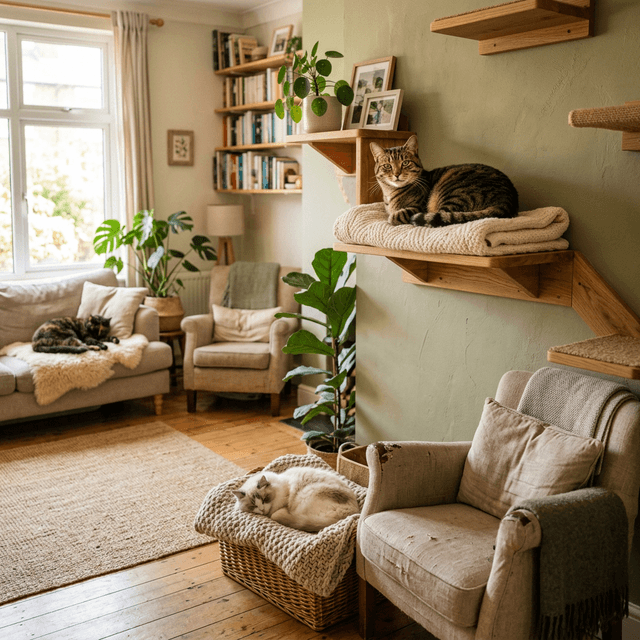
- •safe hiding spots and vertical space
- •pheromone diffusers (optional) in the main room
“It started suddenly in an adult cat.”
Sudden behavior changes deserve a quick health check. Consider:
- •pain (arthritis, nail issues)
- •stress triggers (new pet, move, construction)
- •skin irritation or allergies (less common, but possible)
If the scratching becomes frantic, compulsive, or paired with other changes (hiding, appetite shifts, litter box changes), schedule a vet visit.
A 14-Day Sofa-Saving Plan (Simple and Realistic)
If you like structure, follow this two-week roadmap.
Days 1–3: Set up and protect
- Install sofa protection on the scratched areas.
- Place a tall scratcher directly beside the problem spot.
- Add one horizontal scratcher nearby (especially if you’re not sure of preferences).
- Start enzymatic cleaning of scratched areas (let dry fully).
Days 4–7: Build the habit
- Do 2–3 short training sessions daily (5 minutes).
- Reward scratcher use immediately.
- Redirect calmly every time you catch sofa attempts.
- Add catnip/silvervine lightly if helpful.
Days 8–14: Increase reliability
- Gradually reduce luring; reward spontaneous scratching.
- If your cat uses the scratcher daily, begin moving it a few inches toward a preferred long-term location (optional).
- Keep sofa protection up.
- Add enrichment (play + puzzle feeding) to reduce boredom scratching.
After day 14, many households can start tapering off sofa tape/guards—but only if scratcher use is consistent.
Quick FAQ: Practical Questions Cat Parents Ask
Should I spray repellents on the couch?
Some cat-safe deterrent sprays can help, but they’re often inconsistent and can annoy humans too. Physical barriers (guards/tape) + a great scratcher typically work better.
How many scratchers do I really need?
Minimum: one vertical + one horizontal. Ideal: one per major room your cat spends time in, plus extras in multi-cat homes.
Can I train an older cat?
Yes. Adult cats learn well when the setup is correct and rewards are consistent. You may just need sturdier, more accessible scratchers—especially for seniors.
What if my cat scratches the sofa while maintaining eye contact?
That’s often attention-seeking or a learned “button” that makes you react. Replace that button: reward scratching the post, and proactively give attention/play before the scratching starts.
The Takeaway: A Sofa-Friendly Home That Still Lets Your Cat Be a Cat
To stop cat scratching sofa without punishment, you don’t need to “win” against your cat—you need to outsmart the environment:
- •Put the right scratch surfaces in the right places
- •Make the sofa temporarily boring and unrewarding
- •Reward the behavior you want like it’s your job (because for two weeks, it kind of is)
Most cats aren’t trying to ruin furniture. They’re trying to meet a normal need in the most convenient spot. When you give them a better option—and make it pay off—sofa scratching usually fades fast, and the new habit sticks.
Topic Cluster
More in this topic

Frequently asked questions
Why shouldn't I punish my cat for scratching the sofa?
Punishment can increase stress and anxiety, which often makes scratching worse. It also fails to teach what you want instead, so your cat keeps meeting the same natural need in the same spot.
How do I redirect scratching to a scratching post successfully?
Place a sturdy vertical scratcher right next to the sofa where your cat scratches, then reward immediately when they use it. Make the sofa less rewarding (cover the spot temporarily) and keep the scratcher more appealing with texture your cat prefers.
What if my cat ignores the scratching post and keeps choosing the couch?
Try different orientations and materials (vertical, horizontal, sisal, cardboard) and move the scratcher to the exact high-traffic scratching location. Pair it with short play sessions and treats to build a habit, and ensure your cat has enough enrichment to reduce boredom scratching.
