

guide • Nail Care
How to Trim Black Dog Nails Safely: Find the Quick Easily
Learn how to trim black dog nails safely by identifying the quick without the pink guide, using small cuts and simple visual cues to avoid bleeding.
By PetCareLab Editorial • March 12, 2026 • 13 min read
Table of contents
- Why Black Nails Feel Tricky (And Why It Matters)
- Nail Anatomy in Plain English: What You’re Trying Not to Cut
- Why Black Nails Hide the Quick
- Tools That Make Black Nails Safer (And What I Recommend)
- Clippers vs Grinders: Which Is Safer for Black Nails?
- Product Recommendations (Practical, Not Sponsored)
- Before You Trim: Set Up a “No Drama” Nail Session
- Choose the Right Time
- Positioning That Prevents Sudden Jerks
- Condition the Sound (If Using a Grinder)
- The Safest Method: How to Find the Quick on Black Nails
- The “Tiny Slice” Rule (Works With Clippers or Grinder)
- What You’re Looking For: The Inner Bullseye
- Use the Underside Groove as a Guide
- Step-by-Step: How to Trim Black Dog Nails Safely (Clippers)
- Step 1: Light + Grip
- Step 2: Choose the Cutting Angle
- Step 3: Take a Micro-Trim
- Step 4: Repeat in Tiny Increments
- Step 5: Smooth Edges (Optional but Helpful)
- Step 6: Reward and End on a Win
- Step-by-Step: How to Trim Black Dog Nails Safely (Grinder)
- Step 1: Prep for Safety
- Step 2: Touch-and-Release Technique
- Step 3: Shape, Don’t Chase “Short”
- Step 4: Stop at the “Dot”
- What If You Hit the Quick? (Stay Calm, Fix It Fast)
- What It Looks Like
- What To Do Immediately
- Prevent the “I Hate Nail Trims Now” Problem
- Common Mistakes That Make Black Nails Harder (And How to Avoid Them)
- Mistake 1: Trying to Finish All Nails in One Go
- Mistake 2: Cutting Big Chunks “To Get It Over With”
- Mistake 3: Using Dull Clippers
- Mistake 4: Ignoring Dewclaws
- Mistake 5: Trimming Only When Nails Are “Bad”
- How Often to Trim (And How to Make the Quick Recede)
- Breed and Lifestyle Scenarios (What Changes With Different Dogs)
- Scenario 1: The “Concrete Walker” Lab With Thick Black Nails
- Scenario 2: The Anxious Rescue With Unknown Handling History
- Scenario 3: The Tiny Dog Who Hates Foot Touching (Chihuahua, Yorkie)
- Scenario 4: The Senior Dog With Arthritis
- Expert Tips That Make Black Nails Easier (Not Just Safer)
- Use a “Two-Person” Method When Needed
- Trim After a Bath (Sometimes)
- Keep Notes on “Stop Points”
- Rotate Feet to Reduce Struggle
- When to Get Professional Help (And What to Ask For)
- Quick Reference: Safe Black Nail Trimming Checklist
Why Black Nails Feel Tricky (And Why It Matters)
If you’ve ever trimmed a dog’s white nails, you’ve probably relied on the pink “quick” as a built-in guide. With black dog nails, that visual shortcut disappears—so people either trim too little (leaving nails long and uncomfortable) or they trim too much and hit the quick (pain + bleeding + a dog who now hates nail time).
Here’s the key reality: you can still find the quick in black nails—you just do it differently. The safest approach is to use multiple cues (shape, texture, and the nail’s inner “bullseye”) and take controlled, tiny trims.
Why this matters beyond looks:
- •Long nails change paw mechanics. They push toes apart and alter how your dog bears weight.
- •They increase risk of split nails, broken nails, and licking/chewing.
- •They can worsen discomfort for dogs with arthritis or hip/knee issues.
- •Overgrown nails can curl and puncture paw pads—especially in seniors and small breeds.
If your focus keyword is “how to trim black dog nails safely,” think “safe and repeatable,” not “perfect in one session.”
Nail Anatomy in Plain English: What You’re Trying Not to Cut
A dog’s nail isn’t just “dead keratin.” Inside is living tissue.
- •Nail shell: the hard outer nail you trim.
- •Quick: the sensitive living core (blood vessels + nerves). Cutting it hurts and bleeds.
- •Outer curve vs underside: the underside often shows clues sooner than the top.
Important nuance: the quick grows longer when nails are left long. That’s why a dog with overgrown nails seems “impossible” to trim short. You’re not stuck—you just need a gradual plan.
Why Black Nails Hide the Quick
Pigment in the nail makes the quick invisible from the outside. But the quick still influences:
- •the nail’s internal color pattern after a small cut
- •the nail’s firmness
- •the shape of the cut surface
Tools That Make Black Nails Safer (And What I Recommend)
You can do this with basic tools, but the right setup reduces mistakes.
Clippers vs Grinders: Which Is Safer for Black Nails?
Both can be safe; your choice depends on your dog and your hands.
Guillotine-style clippers
- •Pros: cheap, quick
- •Cons: harder to control tiny slices; can crush thick nails
- •Better for: small dogs with thinner nails (e.g., Chihuahua, Miniature Pinscher)
Scissor/plier-style clippers
- •Pros: stronger; better leverage; cleaner cut
- •Cons: can still take too much if you’re not careful
- •Better for: medium/large dogs (e.g., Lab, Shepherd mixes)
Nail grinder (Dremel-style)
- •Pros: easiest to “sneak up” on the quick; smoother edges; great for black nails
- •Cons: noise/vibration; hair can catch; takes longer
- •Better for: dogs tolerant of sound; anxious dogs who do better with slow increments
If you’re new and your dog will tolerate it, a grinder is often the safest learning tool for black nails because it removes nail in controlled layers.
Product Recommendations (Practical, Not Sponsored)
Look for these features rather than chasing a brand name:
- •Clippers: sharp stainless steel, comfortable grip, safety guard optional (guards can give false confidence)
- •Grinder: variable speed, quiet motor, battery life that won’t die mid-paw
- •Styptic: styptic powder is ideal; styptic pencil works; cornstarch can help in a pinch (less effective)
A solid kit includes:
- •Quality clippers or grinder
- •Styptic powder
- •Bright flashlight or phone light
- •Treats with high value (tiny pieces)
- •Towel or non-slip mat
Pro-tip: Keep styptic open and within arm’s reach before you start. Most people scramble only after they nick the quick—when the dog is already stressed.
Before You Trim: Set Up a “No Drama” Nail Session
A safe trim isn’t just technique—it’s environment and timing.
Choose the Right Time
Best: after a walk or play session when your dog is relaxed. Avoid: right after zoomies, during visitor chaos, or when your dog is already overstimulated.
Positioning That Prevents Sudden Jerks
Pick the position that keeps your dog steady and your view clear.
- •Small dogs: on a table with a non-slip mat; one arm lightly around the chest
- •Medium/large dogs: on the floor, dog lying on side, or standing with you at the shoulder
- •Wiggly dogs: “hug hold” from behind (one arm under belly) can stabilize
Breed examples:
- •Labrador Retriever: often tolerant but nails are thick—use strong clippers or grinder; support each toe.
- •German Shepherd: sensitive feet is common; do shorter sessions; reward heavily.
- •Dachshund: can twist/jerk; table + gentle restraint helps; avoid torquing their long back.
- •Pit Bull–type dogs: nails can be dense; grinder works great; watch for sudden playful head swings.
Condition the Sound (If Using a Grinder)
If the grinder is new:
- Turn it on for 1 second.
- Treat.
- Repeat until the dog stops reacting.
- Touch grinder (off) to shoulder, treat; then paw, treat.
- Only then start brief grinding.
This conditioning is the difference between “my dog fights it” and “my dog tolerates it.”
The Safest Method: How to Find the Quick on Black Nails
When you can’t see the quick, you read the nail.
The “Tiny Slice” Rule (Works With Clippers or Grinder)
Instead of trimming a big chunk:
- •Take 1–2 mm at a time
- •Check the cut surface after each trim
- •Stop as soon as you see early warning signs
This is slower, but it’s the safest way to learn.
What You’re Looking For: The Inner Bullseye
After you take a thin slice off the nail tip, look at the freshly cut surface.
You’ll typically see:
- •Outer ring: hard nail (chalky/grayish)
- •Center: darker or softer area
As you approach the quick, you may see:
- •A small dark dot in the center (early warning)
- •A shiny, moist-looking center (you’re very close)
- •A soft “rubbery” feel instead of dry keratin
Stop when you see the dark dot or the center begins to look glossy. That’s your “close enough for today” point.
Pro-tip: On many black nails, the quick is closest on the top/front area. Aim your trim/grind from the bottom/underside and take thin layers to reduce risk.
Use the Underside Groove as a Guide
Flip the paw slightly and look underneath the nail. Many nails have a natural hollow or groove; as nails get long, that hollow extends. The quick often sits farther forward when nails are overgrown.
Clue: If the nail is very “hooked,” the quick is likely longer than you want—plan multiple sessions.
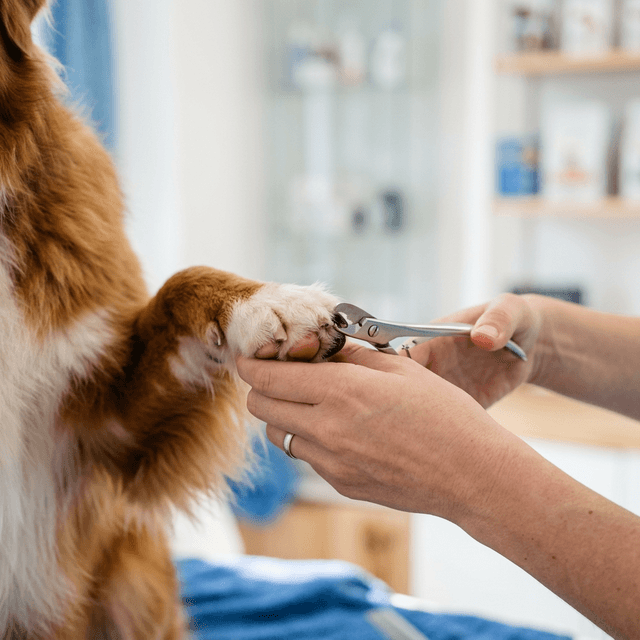
Step-by-Step: How to Trim Black Dog Nails Safely (Clippers)
This method emphasizes control and visibility.
Step 1: Light + Grip
- •Use a bright overhead light plus a flashlight angled at the nail.
- •Hold the paw firmly but gently.
- •Isolate one toe so you’re not twisting the whole foot.
Step 2: Choose the Cutting Angle
For most dogs:
- •Aim to cut at a slight angle following the natural slope of the nail.
- •Avoid a flat straight-across chop; it can split nails and removes too much at once.
Step 3: Take a Micro-Trim
- •Clip just the tip (1–2 mm).
- •Immediately inspect the cut surface.
Step 4: Repeat in Tiny Increments
Trim, check, trim, check. You’re looking for:
- •Chalky/dry = safe territory
- •Central darkening dot = close
- •Shiny/moist center or soft texture = stop
Step 5: Smooth Edges (Optional but Helpful)
If your dog tolerates it, use:
- •a nail file, or
- •one quick pass with a grinder
This reduces snagging and makes nails feel less sharp.
Step 6: Reward and End on a Win
Stop before your dog melts down. If you only finish 2–4 nails today, that’s still progress.
Real scenario:
- •Your Shepherd mix starts pulling away at nail #5. End the session, treat, and do the rest tomorrow. Pushing through is how dogs learn to hate trims.
Step-by-Step: How to Trim Black Dog Nails Safely (Grinder)
Grinders are excellent for black nails because they remove layers slowly.
Step 1: Prep for Safety
- •Tie back long hair; keep feathering fur away from the nail.
- •Use the grinder guard if it helps, but don’t rely on it.
Step 2: Touch-and-Release Technique
Instead of holding the grinder on the nail:
- •Touch nail for 1–2 seconds
- •Pull away
- •Check progress
- •Repeat
This prevents heat buildup.
Step 3: Shape, Don’t Chase “Short”
Focus on rounding the tip and reducing length gradually.
- •Grind the tip
- •Then lightly grind the sides to round
- •Re-check the center
Step 4: Stop at the “Dot”
Same rule: stop when you see the central dot or the cut surface becomes glossy.
Pro-tip: If the nail starts to smell “burnt,” you’re pressing too long in one spot. Touch-and-release, lower speed, and take breaks.
What If You Hit the Quick? (Stay Calm, Fix It Fast)
Even pros occasionally nick a quick—especially with black nails.
What It Looks Like
- •Sudden yelp or flinch
- •Small bead of blood at the nail tip
- •Dog pulls paw away
What To Do Immediately
- Apply styptic powder with firm pressure for 30–60 seconds.
- If needed, repeat once.
- Keep the dog calm and restrict running for a bit.
If you don’t have styptic:
- •Cornstarch or flour can help temporarily, but styptic works better.
When to call a vet:
- •Bleeding won’t stop after 10 minutes of pressure + styptic
- •Nail is cracked/split up toward the nail bed
- •Dog is limping, obsessively licking, or the toe looks swollen later
Prevent the “I Hate Nail Trims Now” Problem
After a quick nick:
- •Stop the session.
- •Give extra-high-value treats.
- •Next session, do one nail only and quit while ahead.
Common Mistakes That Make Black Nails Harder (And How to Avoid Them)
Mistake 1: Trying to Finish All Nails in One Go
If your dog is anxious, forcing completion creates long-term resistance.
- •Better plan: 2–4 nails per session, daily or every other day.
Mistake 2: Cutting Big Chunks “To Get It Over With”
This is the #1 reason people hit the quick.
- •Fix: micro-trims; check the cut surface every time.
Mistake 3: Using Dull Clippers
Dull blades crush and splinter nails, making dogs react.
- •If the clip feels like a crunch, upgrade or sharpen.
Mistake 4: Ignoring Dewclaws
Dewclaws don’t wear down naturally and can curl into the skin. Breed examples:
- •Great Pyrenees may have double dewclaws—check them.
- •Spaniels and mixed breeds often have dewclaws that overgrow quietly.
Mistake 5: Trimming Only When Nails Are “Bad”
Infrequent trimming keeps the quick long.
- •Goal: small, frequent trims to encourage quick recession.
How Often to Trim (And How to Make the Quick Recede)
For most dogs:
- •Every 2–4 weeks is typical.
- •Dogs with fast-growing nails may need weekly maintenance.
If your dog’s nails are long and the quick is extended:
- •Trim/Grind every 5–7 days (tiny amounts) to encourage the quick to recede.
- •Expect visible improvement in 3–6 weeks, sometimes longer.
A practical benchmark:
- •Nails should not click loudly on hard floors during normal walking (some light clicking can happen depending on gait and flooring, but constant tapping is a sign they’re too long).
Breed and Lifestyle Scenarios (What Changes With Different Dogs)
Scenario 1: The “Concrete Walker” Lab With Thick Black Nails
A Lab who walks on sidewalks may naturally wear nails somewhat—but often not enough, especially the dewclaws.
- •Use heavy-duty scissor clippers or a grinder.
- •Expect thick nails: go slower, take smaller slices.
Scenario 2: The Anxious Rescue With Unknown Handling History
A rescue dog may interpret restraint as scary.
- •Start with conditioning: touch paw, treat; touch nail, treat.
- •Do one nail per session for the first week.
- •Grinder may be easier if the dog hates the “clip” sensation.
Scenario 3: The Tiny Dog Who Hates Foot Touching (Chihuahua, Yorkie)
Small dogs can be dramatic about paw handling.
- •Use a table, non-slip mat, and gentle steady hold.
- •Consider a guillotine clipper for thin nails, but only if you can micro-trim confidently.
- •Keep sessions short—under 2 minutes.
Scenario 4: The Senior Dog With Arthritis
Older dogs may not tolerate awkward positions.
- •Trim with the dog lying comfortably on their side.
- •Do shorter sessions and avoid pulling joints into uncomfortable angles.
- •Consider a grinder for controlled shaping without squeezing toes.
Expert Tips That Make Black Nails Easier (Not Just Safer)
Use a “Two-Person” Method When Needed
One person feeds a steady stream of treats (peanut butter on a lick mat works well), the other trims. This reduces sudden movement.
Trim After a Bath (Sometimes)
Nails can be slightly softer after bathing, making grinding smoother.
- •Don’t count on this if nails are very thick; it’s a mild advantage.
Keep Notes on “Stop Points”
If you find the dot on one nail quickly, the others may be similar—but not always. Still, noting “front nails are shorter than back nails” helps you trim consistently.
Rotate Feet to Reduce Struggle
If your dog fights front paws, do a back paw next, then return. Variety can prevent escalation.
Pro-tip: If your dog repeatedly jerks right as you clip, switch to a grinder for a few sessions. The vibration + slow progress can be less startling than the clip pressure.
When to Get Professional Help (And What to Ask For)
Sometimes the safest trim is the one you outsource—especially if:
- •nails are severely overgrown/curling
- •your dog has bitten during grooming
- •you’ve hit the quick multiple times and your dog is now phobic
Where to go:
- •Vet clinic (often best for anxious/painful dogs)
- •Experienced groomer (great for routine maintenance)
What to ask:
- •“Can you shorten gradually over multiple visits to help the quick recede?”
- •“Can you use a grinder to round and smooth after clipping?”
- •“Can I watch so I can learn the bullseye/dot cue for black nails?”
If behavior is a major issue, ask your vet about:
- •anxiety-reduction strategies
- •mild pre-visit meds (when appropriate)
- •cooperative care training resources
Quick Reference: Safe Black Nail Trimming Checklist
- •Light: bright overhead + flashlight
- •Tools: sharp clippers or variable-speed grinder + styptic powder
- •Method: 1–2 mm trims; inspect after each cut
- •Stop signs: central dark dot, glossy/moist center, softer texture
- •Pace: short sessions; end before your dog is done
- •Schedule: frequent micro-trims to shrink the quick over time
If you want, tell me your dog’s breed/size, nail length (clicking? curling?), and whether you prefer clippers or a grinder—I can tailor an exact trimming plan (including how many mm to take and how often) for your situation.
Topic Cluster
More in this topic

guide
How to Trim Dog Nails: A Step-by-Step Guide for Beginners
guide
Nail grinder vs clippers for dogs: which is best for your pet?

guide
Dog Nail Trimming at Home: Safe Step-by-Step Routine (Clippers vs Grinders vs Scratch Boards)
guide
How to Trim Rabbit Nails Without Stress: Calm Home Method
guide
How to Trim Rabbit Nails Safely: Avoid the Quick + Bleeding
guide
How to Trim Rabbit Nails at Home: Quick Stops, Tools & Calm Holds
Frequently asked questions
How do I find the quick in black dog nails?
Trim in tiny increments and check the cut surface after each snip. As you approach the quick, the center looks darker and may appear moist; stop before you see a pink/gray soft spot.
What should I do if I cut my dog's quick?
Apply styptic powder or cornstarch with firm pressure until bleeding stops, then keep your dog calm and avoid re-trimming that nail for a few days. If bleeding won’t stop after several minutes, contact your vet.
Is it better to clip or grind black dog nails?
Grinding is often easier for black nails because you can remove small amounts gradually and reassess frequently. Clippers work too, but use very small cuts and stop often to inspect the nail.
