

guide • Litter Box Management
Cat Litter Tracking Control: Mats, Paths, and Vacuum Workflow
Stop litter from spreading through your home with smarter mats, better entry paths, and a vacuum-first routine that actually reduces tracking.
By PetCareLab Editorial • March 5, 2026 • 14 min read
Table of contents
- Why Litter Tracking Happens (and Why “Just Sweep More” Fails)
- Start With a Quick Tracking Audit (5 Minutes That Saves You Money)
- The Tracking Map Test
- What the Pattern Usually Means
- Mats That Actually Work: Materials, Shapes, and Placement Strategy
- The 3 Mat Types (and What They’re Best For)
- Mat Size and Shape: The “Bigger Than You Think” Rule
- Placement: Make the Mat Unavoidable (Without Blocking Access)
- Product Recommendations (Mat Category)
- Entry Paths and “Landing Zones”: Design the Exit Like a Mini Mudroom
- The Runway Method (Best for Hallway Exits)
- The Corner Pen Method (Best for Small Apartments)
- The Two-Texture Trick (A Behavioral Nudge)
- Litter Box and Litter Choices That Reduce Tracking (Without Causing Box Avoidance)
- Box Style: What Helps Most
- Litter Type: Tracking vs. Acceptance Trade-Offs
- Practical Recommendation
- The Vacuum Workflow That Actually Helps (and Doesn’t Just Spread Litter)
- Step-by-Step: Daily “2-Minute Reset”
- Weekly: The “Zone Clean” (10–15 Minutes)
- Vacuum Type: What Matters
- Real-World Setups (By Cat Type and Home Layout)
- Scenario 1: Maine Coon in a Hardwood + Area Rug Living Space
- Scenario 2: Bengal in an Apartment Bathroom
- Scenario 3: Senior Domestic Shorthair With Arthritis
- Scenario 4: Two Cats, One Litter Room, Constant Traffic
- Product Recommendations and Comparisons (What to Buy and Why)
- The “Best Value” Starter Kit
- The “Sensitive Paw” Kit
- The “Pellet Litter” Kit
- Quick Comparison: Honeycomb vs. Fabric Mats
- Common Mistakes That Make Tracking Worse (Even With “Good” Products)
- Expert Tips for Long-Haired Cats, Kittens, and Picky Cats
- Long-Haired Breeds: Toe Tuft Management
- Kittens: Build Good Exit Habits Early
- Picky Cats: Don’t Break What’s Working
- A Simple 14-Day Plan to Cut Tracking Fast
- Days 1–3: Measure and Observe
- Days 4–7: Install the Capture System
- Days 8–14: Optimize
- Quick Checklist: Your Minimal “Tracking Control” Setup
Why Litter Tracking Happens (and Why “Just Sweep More” Fails)
Cat litter tracking is rarely a single-problem issue. It’s usually the combination of:
- •Litter physics (small granules + low weight = easy to fling and stick)
- •Cat anatomy (fur, toe fluff, and paw pad texture hold particles)
- •Box behavior (digging, high-energy exits, “launch” jumps)
- •Home layout (hard floors, runners, tight corners, HVAC airflow)
- •Cleaning workflow (wrong tools or wrong order = you spread litter farther)
In vet-tech real life, I see tracking explode in three common households:
- The “Fluffy Feet” home: Maine Coon, Ragdoll, Siberian, Birman, and Persian types often have toe tufts and longer fur that grab fine litter like Velcro.
- The “Speed Racer” home: Bengals, Abyssinians, Oriental Shorthairs, and many young mixed-breed cats rocket out of the box after a big dig.
- The “Multi-Cat Traffic” home: Two or more cats means the area gets used like a hallway, and litter migrates with every pass.
The goal isn’t perfection. The goal is a setup where most litter drops back into a mat or landing zone, and the rest can be cleaned quickly without redistributing it.
Start With a Quick Tracking Audit (5 Minutes That Saves You Money)
Before you buy anything, figure out how and where your litter is escaping. Here’s a simple audit:
The Tracking Map Test
- Scoop the box and smooth the litter surface.
- Place a dark towel or sheet around the box for 24 hours (or use painter’s paper).
- Note:
- •Where pawprints appear first
- •The “launch direction” (most cats have a consistent exit path)
- •Whether litter is concentrated near the box (mat issue) or far away (workflow/traffic issue)
What the Pattern Usually Means
- •Piles right outside the box: cat is kicking litter out; consider box style/height or a better entry path.
- •A trail down one hallway line: cat exits fast; you need a longer “runway” and better mat capture.
- •Specks everywhere, including furniture: litter is dusty or sticking to fur; consider litter type and vacuum workflow.
Pro-tip: If you see litter on beds/sofas, it’s often not “tracking” anymore—it’s transfer from paws to soft fabric, which means you need a better capture zone before the cat hits carpet or upholstery.
Mats That Actually Work: Materials, Shapes, and Placement Strategy
A good mat doesn’t just “sit there.” It forces litter to fall off paws and contains it until you remove it.
The 3 Mat Types (and What They’re Best For)
1) Honeycomb “double-layer” mats
- •How they work: top layer has holes; litter falls through into a lower trap layer.
- •Best for: most homes, especially fine or medium clumping litter.
- •Watch-outs:
- •Some cats dislike the texture (especially seniors with arthritis).
- •If urine hits it, it can trap odor—clean promptly.
2) Ribbed or tufted fabric mats (low pile)
- •How they work: fibers brush paws; litter stays on top.
- •Best for: cats that hate rough textures; homes with sensitive paws (older cats, declawed rescues, post-surgery).
- •Watch-outs:
- •Harder to empty completely.
- •Can hold dust if you don’t vacuum.
3) Microfiber “bath mat” style
- •How they work: plush fibers catch litter and moisture.
- •Best for: homes with pellet litters or cats that step out with damp paws.
- •Watch-outs:
- •Litter can embed deep; needs shaking + vacuuming.
- •Can become a “pee target” for some cats (soft texture resembles a bathroom rug).
Mat Size and Shape: The “Bigger Than You Think” Rule
Most tracking happens in the first 2–4 steps after exiting. For large breeds (Maine Coon) or long-bodied cats (Oriental Shorthair), it can be more.
A practical rule:
- •Minimum: mat length = 2.5x the cat’s body length (nose-to-base of tail)
- •Better: create a runway so the cat must step on mat for several paces
Placement: Make the Mat Unavoidable (Without Blocking Access)
- •Put the mat exactly where the cat exits, not where you wish they’d exit.
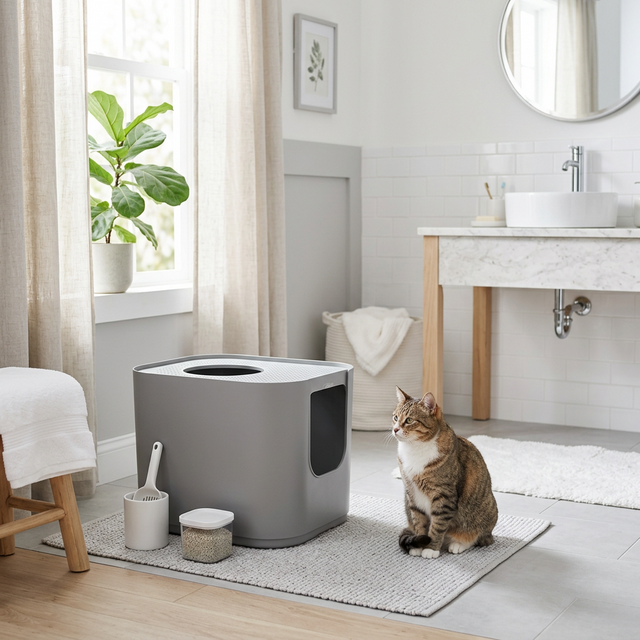
- •If you have a top-entry or hooded box with front exit, build a straight landing path.
- •If the cat “side-hops” out, rotate the box so the preferred exit points to the mat.
[IMAGE_PLACEHOLDER_1]
Product Recommendations (Mat Category)
These are reliable styles and what to look for (you can match brands based on budget):
- •Best overall for cat litter tracking control: double-layer honeycomb EVA mat with waterproof bottom, beveled edge
- •Best for sensitive paws: soft ribbed low-pile mat with nonslip backing
- •Best for pellets: microfiber mat with tight stitching + machine-washable (check tag)
When comparing mats, prioritize:
- •Non-slip backing (especially on tile)
- •Beveled edge (prevents tripping and corner curling)
- •Easy-empty design (open-and-pour or shake without dumping everywhere)
Entry Paths and “Landing Zones”: Design the Exit Like a Mini Mudroom
The difference between a “mat” and a real system is the entry path: a deliberate route that makes the cat walk over capture surfaces before they hit the rest of the house.
The Runway Method (Best for Hallway Exits)
If your litter box is near a hallway or open space, build a 2-step runway:
- Primary capture mat directly outside the box (honeycomb or ribbed)
- Secondary runner (washable, low pile) extending 2–4 feet in the direction the cat naturally travels
This works especially well for:
- •Bengals and young cats that sprint out after digging
- •Multi-cat homes where traffic is constant
The Corner Pen Method (Best for Small Apartments)
If space is tight, use a “three-wall” effect:
- •Place the box so the exit faces a wall corner, forcing a slow turn.
- •Put the mat in the only available “turn lane.”
- •Add a small side mat to block alternative exits.
The Two-Texture Trick (A Behavioral Nudge)
Cats often avoid stepping on weird textures—use that gently:
- •Put a pleasant texture (soft ribbed mat) as the “approved” exit
- •Put a less preferred but safe texture (thin, firm runner) to discourage side exits
Avoid anything that could hurt paws (no rough bristles). Your aim is guidance, not punishment.
Pro-tip: For a long-haired Ragdoll or Siberian, pair a honeycomb mat with a soft runner. The honeycomb catches most granules; the runner captures what’s stuck in toe fluff on the next few steps.
Litter Box and Litter Choices That Reduce Tracking (Without Causing Box Avoidance)
You can buy the best mat in the world and still lose the battle if the box and litter are wrong for your cat.
Box Style: What Helps Most
High-sided open boxes
- •Great for: cats who kick litter out the sides
- •Watch-outs: seniors may struggle to climb in; cut-down entry can help
Top-entry boxes
- •Great for: cats that launch litter forward
- •Often excellent for: shorthaired athletic cats (Abyssinian, Bengal)
- •Watch-outs: not ideal for very large cats (big Maine Coons may feel cramped), or for cats with mobility issues
Covered/hooded boxes
- •Can reduce visible mess
- •But: some cats dislike trapped odors and may avoid the box (common complaint in behavior consults)
- •If you use one, prioritize:
- •Good ventilation
- •Regular deep cleaning
- •A doorless hood (many cats hate swinging flaps)
Litter Type: Tracking vs. Acceptance Trade-Offs
Tracking control is about particle size, weight, and static, but your cat’s preferences matter more. A cat that hates the litter will “protest” by perching on edges or launching out faster.
Fine clay clumping (sand-like)
- •Pros: popular with cats, good clumping
- •Cons: tracks the most, sticks to fur, dusty varieties spread everywhere
Medium-grain clay
- •Pros: less tracking than fine, still acceptable to many cats
- •Cons: can still migrate; choose low-dust
Pellet litter (wood/paper)
- •Pros: heavier, less dust, often less far-distance tracking
- •Cons: pellets can get kicked; some cats dislike the feel; urine breaks pellets into sawdust that can still spread
Crystals/silica
- •Pros: low dust, less sticking
- •Cons: some cats dislike the texture; can be painful for sensitive paws; doesn’t “clump scoop” the same way
Practical Recommendation
If your main goal is cat litter tracking control and your cat isn’t picky, try:
- •Switching from fine to medium-grain low-dust clumping litter first (least disruptive change)
- •Pairing it with a double-layer honeycomb mat and a runway
Make litter changes gradually:
- •Mix 25% new litter for several days, then increase weekly.
The Vacuum Workflow That Actually Helps (and Doesn’t Just Spread Litter)
Most people clean in the wrong order: they sweep or vacuum randomly, scattering litter into corners and embedding it into rugs.
Here’s a workflow that’s efficient and reduces re-tracking.
Step-by-Step: Daily “2-Minute Reset”
- Pick up visible clumps of litter by hand or with a small handheld broom (don’t push it outward).
- Lift/empty the mat (if honeycomb): pour trapped litter back into the box or into trash (your preference).
- Quick vacuum pass around the perimeter (12–18 inches beyond the mat edges).
The secret is that you remove the bulk first, then vacuum the fine bits.
Weekly: The “Zone Clean” (10–15 Minutes)
- Remove mats and runner; shake them into a trash bag or outside.
- Vacuum the floor starting farthest from the box, moving toward it.
- Vacuum the mat last (or rinse/clean it, depending on type).
- Wipe hard floor with a barely damp microfiber (dry afterward).
Why far-to-near works: you avoid stepping through the “dirty zone” and dragging litter outward.
Vacuum Type: What Matters
- •Best overall: a vacuum with strong suction + sealed filtration (helps with litter dust)
- •Best for daily spot-work: handheld vacuum kept near the litter area
- •For carpet edges: a crevice tool is non-negotiable (litter loves baseboards)
Avoid:
- •Flimsy stick vacs that scatter litter with airflow
- •Vacuuming big pellets with narrow heads that clog repeatedly (you’ll stop using it)
Pro-tip: Keep a dedicated handheld vacuum charged near the litter station. Convenience is the difference between “every day” and “once a week when it’s bad.”
[IMAGE_PLACEHOLDER_2]
Real-World Setups (By Cat Type and Home Layout)
Scenario 1: Maine Coon in a Hardwood + Area Rug Living Space
Problem: toe tufts grab fine litter; big body means long stride and more scatter.
Setup
- •Large high-sided box with a low entry cut-out
- •Medium-grain clumping litter (low dust)
- •Extra-large honeycomb mat + 3–4 ft low-pile runner leading away from rugs
- •Weekly paw check: trim toe fluff slightly if your cat tolerates grooming
Common mistake
- •Using a tiny mat that only catches step #1.
Scenario 2: Bengal in an Apartment Bathroom
Problem: high-energy exits, enthusiastic digging.
Setup
- •Top-entry box (if mobility is good)
- •Honeycomb mat placed to catch the landing step
- •“Corner pen” layout to force a slow turn
- •Daily 2-minute reset with handheld vacuum
Common mistake
- •Covered box with flap door: many Bengals will body-check the flap and fling litter harder.
Scenario 3: Senior Domestic Shorthair With Arthritis
Problem: sensitive paws; reluctant to step on rough mats; may pee at edge if uncomfortable.
Setup
- •Low-entry box, high back wall for kick control
- •Soft ribbed mat (comfortable)
- •Short, gentle runway (avoid trip hazards)
- •Vacuum workflow focused on frequent light cleaning to reduce dust irritation
Common mistake
- •Switching to rough-textured mats that the cat refuses to step on, causing side exits and more tracking.
Scenario 4: Two Cats, One Litter Room, Constant Traffic
Problem: the area becomes a highway; litter migrates via paws even when boxes are fine.
Setup
- •Two boxes minimum (ideally 3 for 2 cats), spaced to reduce congestion
- •Separate mats for each box to prevent overload
- •Runner “lane” that funnels all exits
- •Weekly deep vacuum of baseboards + corners
Common mistake
- •One oversized mat for two boxes; it becomes saturated with litter and stops capturing effectively.
[IMAGE_PLACEHOLDER_3]
Product Recommendations and Comparisons (What to Buy and Why)
You don’t need a shopping spree. You need the right combination for your home and cat.
The “Best Value” Starter Kit
- •Double-layer honeycomb EVA mat (waterproof bottom, large size)
- •Handheld vacuum with a crevice tool
- •Low-pile washable runner (optional but high impact)
Why it works: captures bulk + makes daily maintenance easy.
The “Sensitive Paw” Kit
- •Soft ribbed mat (low pile, nonslip)
- •High-sided low-entry box
- •Medium-grain low-dust clumping litter
- •Optional: air purifier near litter area if dust triggers sneezing
Why it works: keeps comfort high so the cat uses the box normally (less frantic exits).
The “Pellet Litter” Kit
- •Microfiber capture mat
- •Wide-head vacuum (pellets can clog narrow intakes)
- •A small dustpan for quick pellet pickup
Why it works: pellets are heavier but need quick removal before they roll outward.
Quick Comparison: Honeycomb vs. Fabric Mats
- •Honeycomb: best at trapping and easy-empty; can be uncomfortable for some cats
- •Fabric/ribbed: more comfortable; harder to empty completely; can hold dust
If you’re unsure, choose comfort first. A mat your cat avoids is worse than no mat.
Common Mistakes That Make Tracking Worse (Even With “Good” Products)
These are the patterns I see when someone says, “I bought a mat and it didn’t help.”
- Mat is too small
- •If the cat can step over it or only hits it with one paw, it won’t work.
- Mat is placed wrong
- •Put it where the cat actually exits, based on your tracking map.
- Wrong litter for the cat’s coat
- •Fine litter + long-haired toe fluff = constant migration.
- Vacuuming before emptying the mat
- •You’ll blow litter around and embed it into carpet edges.
- Covered box traps odor
- •Cat rushes, perches, or avoids the box entirely.
- Overfilling the box
- •More litter depth can mean more kick-out if the cat digs enthusiastically.
Expert Tips for Long-Haired Cats, Kittens, and Picky Cats
Long-Haired Breeds: Toe Tuft Management
For Maine Coons, Ragdolls, Siberians, and Persians:
- •Consider a gentle sanitary/foot trim from a groomer if tracking is extreme.
- •Use medium-grain litter rather than sand-fine.
- •Add a secondary runner to catch “delayed drop-off.”
Kittens: Build Good Exit Habits Early
Kittens often explode out of the box.
- •Use a runway from day one.
- •Keep mats soft; kittens can be texture-sensitive.
- •Vacuum daily (kittens are messy, and you’ll protect your own sanity).
Picky Cats: Don’t Break What’s Working
If your cat is stable with box habits, don’t change everything at once.
- •Change one variable every 7–10 days: mat first, then runner, then litter type if needed.
- •Watch for signs of stress: hesitation, perching, going beside the box.
Pro-tip: The best cat litter tracking control setup is the one your cat uses confidently. A small amount of litter on the floor is easier than fixing a litter box avoidance problem.
A Simple 14-Day Plan to Cut Tracking Fast
If you want a clear path, follow this:
Days 1–3: Measure and Observe
- Do the tracking map test.
- Note exit direction and “hot zones.”
- Decide whether your biggest issue is kick-out, fur carry, or speed exits.
Days 4–7: Install the Capture System
- Place a correctly sized mat in the exit zone.
- Add a runner if you have hallway-style tracking.
- Start the daily 2-minute reset.
Days 8–14: Optimize
- If tracking is still high:
- •Increase mat size
- •Adjust box orientation to force mat contact
- If litter is still showing up on furniture:
- •Evaluate litter dust and grain size
- •Consider coat management for long-haired cats
- Lock in weekly zone clean.
By the end of two weeks, most homes see a meaningful reduction—often not zero litter, but dramatically less spread and less “grit underfoot.”
Quick Checklist: Your Minimal “Tracking Control” Setup
If you only do a few things, do these:
- •Mat is large and unavoidable at the exit
- •Entry path/runway guides the first 2–4 steps
- •Litter grain and dust level match your cat’s coat and preferences
- •Vacuum workflow: empty mat first, then vacuum far-to-near
- •Comfort first: seniors and sensitive cats need softer mats and easy-entry boxes
If you tell me your cat’s breed/coat type, litter type, and where your box sits (bathroom, closet, laundry room, open corner), I can suggest the most efficient layout and which mat style is most likely to work in your specific space.
Topic Cluster
More in this topic
Frequently asked questions
What actually works best for cat litter tracking control?
Use a high-capture mat right at the exit, then force a short “entry path” (runner or textured tiles) that makes your cat take a few steps before hitting open floor. Pair it with a vacuum-first routine so litter is removed before it gets ground into paws and carried farther.
Where should I place litter mats to reduce tracking the most?
Place the primary mat immediately outside the box where your cat lands, and extend coverage in the direction they naturally exit. If your cat launches out, add a secondary mat or runner a few feet out to catch what shakes loose after the first steps.
What is the best cleaning order to keep litter from spreading?
Vacuum the area around the box first to pick up loose granules before you walk through them and redistribute them. Then spot-wipe hard floors and finally shake/clean mats last, so you don’t reintroduce litter onto freshly cleaned surfaces.
