
guide • Litter Box Management
Multi Cat Litter Box Setup: N+1 Rule, Placement & Cleaning
Set up a stress-free multi cat litter box setup with the N+1 formula, smart placement, and a simple cleaning schedule that prevents guarding and accidents.
By PetCareLab Editorial • March 6, 2026 • 15 min read
Table of contents
- The “N+1” Litter Box Setup Formula (And When to Break It)
- When N+1 isn’t enough (common multi-cat exceptions)
- When you can sometimes get away with fewer (and why I still don’t love it)
- Placement Rules That Actually Work (Not Just “Different Rooms”)
- The “3 S’s” placement checklist: Safe, Separate, Simple
- Don’t “stack” boxes in one spot and call it multiple boxes
- Real-world placement examples (multi-cat home scenarios)
- Locations to avoid (even if they’re convenient for humans)
- Step-by-Step: Build a Multi Cat Litter Box Setup in One Afternoon
- Step 1: Count boxes and pick types
- Step 2: Pick one litter and one “test litter”
- Step 3: Place boxes using the “triangle method”
- Step 4: Make the area cat-friendly
- Step 5: Introduce changes without drama
- Choosing the Right Boxes: Open vs Covered vs Top-Entry (With Multi-Cat Pros/Cons)
- Open boxes (often best for multi-cat homes)
- Covered boxes
- Top-entry boxes
- My practical recommendation for most multi-cat homes
- Litter Choices That Reduce Odor Without Making Cats Boycott the Box
- What most cats accept best
- Low-dust options for sensitive cats (breed and health examples)
- Pellet litters (wood/paper) in multi-cat homes
- Comparing clumping vs non-clumping (in daily life)
- Cleaning Frequency: The Multi-Cat Schedule That Prevents Accidents
- The baseline schedule (works for most)
- Adjusting the schedule by cat type (realistic examples)
- Step-by-step deep clean (without making the box smell “wrong”)
- Product Recommendations (Vet-Tech Practical): What I’d Buy for a Multi-Cat Home
- Boxes: what tends to work best
- Scoops and tools that matter
- Odor control that doesn’t offend cats
- For busy homes: litter robots and automatic boxes (honest take)
- Common Multi-Cat Mistakes That Trigger Accidents (And How to Fix Them)
- Mistake 1: “All boxes in the basement/laundry room”
- Mistake 2: Using scented litter or heavy deodorizers to fight odor
- Mistake 3: Boxes are too small (especially with big breeds)
- Mistake 4: Covered boxes with one exit in a “trap” location
- Mistake 5: Punishing a cat for accidents
- Expert Tips for Smooth Multi-Cat Harmony (Behavior + Health Monitoring)
- Use boxes to reduce conflict (not create it)
- Track what each cat is doing (without becoming a detective)
- Transitioning litter or boxes without chaos
- Introducing a new cat: litter box strategy that prevents stress
- Quick Setup Templates (Copy/Paste Plans for 2, 3, and 4 Cats)
- 2 cats (3 boxes)
- 3 cats (4 boxes)
- 4 cats (5 boxes)
- Troubleshooting: If You’re Still Smelling Odor or Seeing Avoidance
- Fast diagnostic checklist (10 minutes)
- If one cat is the problem user
- If odor is the main issue
- The Bottom Line: Your Multi-Cat Formula in One Sentence
The “N+1” Litter Box Setup Formula (And When to Break It)
The gold-standard rule for a multi cat litter box setup is:
Number of boxes = number of cats (N) + 1
So:
- •2 cats → 3 boxes
- •3 cats → 4 boxes
- •4 cats → 5 boxes
Why it works: cats are clean, territorial, and routine-driven. Extra boxes reduce competition, prevent “guarding,” and give each cat a backup when a box is temporarily “unacceptable” (too smelly, wrong litter texture, someone just used it, loud location, etc.).
When N+1 isn’t enough (common multi-cat exceptions)
Some homes need N+2 or more, especially when you have:
- •One “traffic cop” cat who guards doorways or ambushes siblings leaving the box
- •A senior cat with arthritis who can’t comfortably travel far
- •A kitten still learning box habits (or who gets distracted mid-hunt/play)
- •A large breed (Maine Coon, Norwegian Forest Cat) that simply needs more space and may avoid cramped boxes
- •A shy breed personality (many Ragdolls and some rescued Persians) who will hold it if the box feels exposed
- •Cats on urinary diets (they pee more) or with mild GI issues (they go more often)
When you can sometimes get away with fewer (and why I still don’t love it)
If your cats are a bonded pair, both healthy adults, and you scoop like it’s your part-time job, you might manage with N boxes. But if anything changes—new cat, new litter, new schedule, stress event, minor UTI—“just enough” turns into “not enough” fast. In multi-cat homes, prevention beats troubleshooting every time.
Pro-tip: If you’re unsure, start with N+1 and observe behavior for 2 weeks. It’s easier to remove a box later than to fix a peeing-outside-the-box habit once it becomes learned behavior.
Placement Rules That Actually Work (Not Just “Different Rooms”)
Placement is where most multi-cat setups fail. The best litter box in the world won’t get used if the route to it feels unsafe or the location feels trapped.
The “3 S’s” placement checklist: Safe, Separate, Simple
A great location is:
- •Safe: no ambush points, no loud appliances, no narrow dead-ends
- •Separate: not all boxes in one line or one closet; cats need choices
- •Simple: easy to access, easy for you to scoop, and easy for cats to reach
Don’t “stack” boxes in one spot and call it multiple boxes
Two boxes side-by-side in the same corner often function like one big territory in a cat’s mind—especially with a confident “owner” cat. For true choice, spread them out.
Real-world placement examples (multi-cat home scenarios)
Scenario 1: Two-story home with 3 cats (one shy, one bold, one senior)
- •Upstairs: 2 boxes (one near bedrooms, one near hallway landing)
- •Downstairs: 2 boxes (one quiet office corner, one living area but away from foot traffic)
- •Senior cat gets a box close to resting spots to avoid stairs.
Scenario 2: Apartment with 2 cats and limited space
- •Box 1: bathroom corner (door wedged open or a cat door)
- •Box 2: bedroom closet with the door modified (baby latch so it stays ajar)
- •Box 3: living room hidden behind a room divider or console table
Key idea: visual privacy + multiple routes so no one gets cornered.
Scenario 3: 4 cats, one bully, one anxious rescue
- •Place boxes so there are two exit paths whenever possible (open area, not inside a tight closet)
- •Add one box in a “no ambush” zone—a room the bully doesn’t control
- •Use baby gates with small pet doors if needed to create safe access for smaller/shyer cats
Locations to avoid (even if they’re convenient for humans)
- •Next to washing machines/dryers (sudden noise = “danger zone”)
- •Dead-end closets where a cat can be trapped
- •Near food and water (most cats dislike toileting near eating areas)
- •High-traffic hallways where kids/dogs rush past
- •Directly beside another cat’s favorite nap spot (can create guarding)
Pro-tip: Think like a cat leaving the box: “Can I get out quickly if something startles me?” If the answer is no, that box will be underused.
[IMAGE_PLACEHOLDER_1]
Step-by-Step: Build a Multi Cat Litter Box Setup in One Afternoon
If you’re setting up from scratch (or rebooting after accidents), do it systematically. Cats like consistency, and your goal is to remove “decision points” that lead to avoidance.
Step 1: Count boxes and pick types
- Start with N+1 boxes.
- Choose at least two different box styles if you’re unsure what they prefer (example: one large open pan + one high-sided).
- Ensure every box is big enough: minimum guideline is 1.5x your cat’s body length (nose to base of tail).
Breed examples:
- •Maine Coon / Savannah / large mixed breeds: prioritize jumbo boxes; cramped boxes cause “perching” and missed urine.
- •Persian / Exotic Shorthair: often prefer easy entry and clean boxes (flat faces + long coats can make them more sensitive to dusty litter).
- •Ragdoll: many tolerate covered boxes, but still prefer roomy and not stuffy.
Step 2: Pick one litter and one “test litter”
Start simple:
- •Use unscented clumping litter as your baseline (most universally accepted).
- •If you want to experiment, test one alternate litter in one box (not all at once).
Step 3: Place boxes using the “triangle method”
For 2–3 cats, imagine a triangle across your home:
- •Put boxes at three different points (not in a line).
- •Include at least one box on each level of a multi-story home.
Step 4: Make the area cat-friendly
- •Add a small mat to catch litter (helps tracking)
- •Keep lighting gentle (a night light can help seniors)
- •Ensure the box is stable (no wobbling lids, no sliding)
Step 5: Introduce changes without drama
- •Don’t carry cats to the box repeatedly (some interpret that as punishment).
- •Let them explore. Reward calm investigation with a treat nearby (not inside the box).
Choosing the Right Boxes: Open vs Covered vs Top-Entry (With Multi-Cat Pros/Cons)
No single box style fits every home, but in multi-cat situations, function beats aesthetics.
Open boxes (often best for multi-cat homes)
Pros
- •Great ventilation (less odor buildup)
- •Cats can scan surroundings (reduces fear)
- •Easier to scoop thoroughly
Cons
- •More tracking and occasional scatter
- •Some cats want more privacy
Best for:
- •Cats with anxiety around confinement
- •Homes with “guarding” behavior (fewer trap feelings)
- •Larger breeds needing space
Covered boxes
Pros
- •Better litter containment
- •Visual privacy (some cats like it)
- •Looks tidier
Cons
- •Odors concentrate inside (cats have sensitive noses)
- •One entrance can create a “trap”
- •Some cats avoid them completely
Best for:
- •Confident cats who prefer privacy
- •Single-cat homes more than multi-cat, unless you have multiple exits (some models)
Top-entry boxes
Pros
- •Great for tracking control
- •Can reduce dog access to cat waste
- •Some cats enjoy the “vault” feel
Cons
- •Hard for seniors/arthritis cats
- •Not ideal for very large cats
- •Can discourage cats with mobility issues or timid personalities
Best for:
- •Athletic young adults
- •Homes with dogs that raid litter boxes
My practical recommendation for most multi-cat homes
Use a mix:
- •Majority open, jumbo, high-sided boxes
- •One covered or one top-entry only if you know at least one cat prefers it (or you need dog-proofing)
Pro-tip: If you use covered boxes, remove the door flap at first. Many cats dislike pushing through it, especially in multi-cat homes where they want a quick exit.
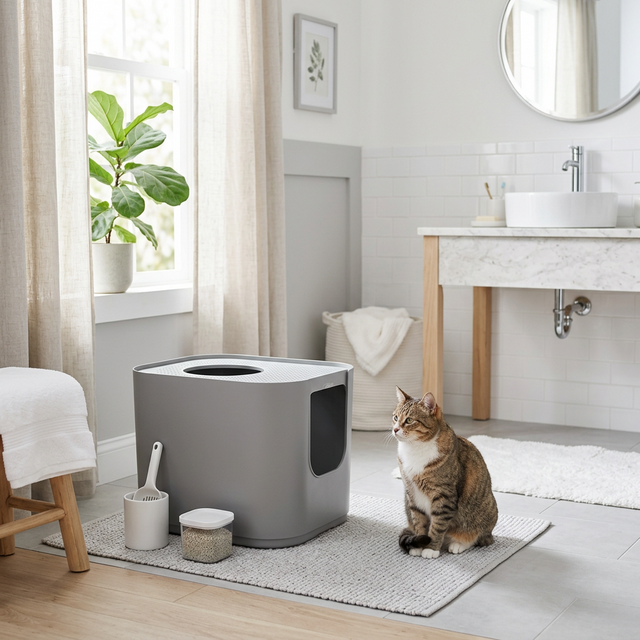
[IMAGE_PLACEHOLDER_2]
Litter Choices That Reduce Odor Without Making Cats Boycott the Box
Your goal is high acceptance first, odor control second. In multi-cat homes, the best litter is the one they reliably use.
What most cats accept best
- •Unscented clumping clay (fine to medium grain) is still the most widely tolerated.
- •Avoid heavy perfumes—cats’ noses are far more sensitive than ours.
Low-dust options for sensitive cats (breed and health examples)
- •Persians and Himalayans (prone to watery eyes) may do better with low-dust formulas.
- •Cats with asthma-like symptoms can react to dusty litter. If you notice coughing near the box, consider a low-dust alternative.
Pellet litters (wood/paper) in multi-cat homes
Pellets can work beautifully, but they’re a “texture change,” and texture is a big deal to many cats.
- •Pros: low tracking, good odor control, often low dust
- •Cons: some cats dislike the feel; urine can pool if not managed properly
If you want to switch:
- Put pellets in one box only.
- Keep the other boxes the usual litter.
- Track which box gets used.
Comparing clumping vs non-clumping (in daily life)
- •Clumping: easiest to keep “fresh” with frequent scooping; best for odor control if you scoop often.
- •Non-clumping: can get swampy in multi-cat homes; requires more frequent full changes.
Cleaning Frequency: The Multi-Cat Schedule That Prevents Accidents
This is the part most people underestimate. In multi-cat homes, cleaning isn’t just about smell—it’s about behavior and health monitoring.
The baseline schedule (works for most)
- •Scoop: 1–2 times daily
- •Top off litter: as needed (usually every few days)
- •Full change + wash box: every 2–4 weeks (depends on litter type and number of cats)
A practical rule:
- •If you have 3+ cats, plan on twice daily scooping if you want consistent box use and low odor.
Adjusting the schedule by cat type (realistic examples)
- •Kittens: scoop more often; they go frequently and are learning habits.
- •Senior cats: need cleaner boxes; they may avoid stepping into soiled litter.
- •Cats on wet food or urinary diets: expect more urine volume; scoop and top off more.
Step-by-step deep clean (without making the box smell “wrong”)
- Dump litter into a trash bag.
- Wash box with unscented soap and warm water.
- Rinse thoroughly (residue can cause avoidance).
- Dry fully.
- Add litter to the right depth (usually 2–3 inches for clumping litter).
- Optional: a light sprinkle of baking soda under the litter (not a scented deodorizer).
Avoid:
- •Strong bleach smell (even if it’s “clean,” it can scream “unsafe” to a cat)
- •Scent boosters that mask odor to humans but repel cats
Pro-tip: If one cat is peeing outside the box, don’t just “add deodorizer.” Treat it like a data point: stress, bullying, box aversion, or a medical issue (UTI, crystals) could be driving it.
Product Recommendations (Vet-Tech Practical): What I’d Buy for a Multi-Cat Home
These are category-level picks so you can match them to your budget and space. In multi-cat homes, prioritize capacity, easy cleaning, and odor containment without perfume.
Boxes: what tends to work best
- •Jumbo open high-sided box: best all-around for multi-cat homes and large breeds; easy to scoop, hard to boycott
- •Low-entry senior-friendly box: ideal for arthritis cats or post-surgery recovery
- •Top-entry box: useful for dog-proofing and tracking control (only if cats can comfortably use it)
Quick comparison:
- •If your biggest issue is misses/spray: choose high-sided or add a tall splash guard.
- •If your biggest issue is guarding/ambush: choose open and place in two-exit areas.
- •If your biggest issue is tracking: consider top-entry for one station + better mats.
Scoops and tools that matter
- •Metal scoop (durable, less odor retention than plastic)
- •Litter mat with easy shake-out design (reduces “sand trails”)
- •Handheld vacuum nearby (sounds silly until you use it daily)
Odor control that doesn’t offend cats
- •Activated charcoal deodorizer near (not in) the box area
- •Air purifier in the litter room (especially with 3+ cats)
- •Good ventilation beats fragrances every time
For busy homes: litter robots and automatic boxes (honest take)
Automatic boxes can be great—if your cats accept them and you still maintain them properly.
- •Pros: frequent sifting reduces “grossness,” helpful for people with mobility issues
- •Cons: some cats fear movement/noise; units can bottleneck if you have multiple cats; still need regular cleaning and emptying
If you go automatic:
- •Use at least one traditional box as backup.
- •Expect an adjustment period of 2–4 weeks.
- •For 3–4 cats, you may need more than one automatic unit depending on capacity.
[IMAGE_PLACEHOLDER_3]
Common Multi-Cat Mistakes That Trigger Accidents (And How to Fix Them)
These are the patterns I see over and over, especially after a new cat is introduced or someone moves homes.
Mistake 1: “All boxes in the basement/laundry room”
Fix:
- •Put at least one box on the main living level.
- •Add a box in a quiet, safe area where a timid cat spends time.
Mistake 2: Using scented litter or heavy deodorizers to fight odor
Fix:
- •Switch to unscented litter.
- •Increase scooping frequency.
- •Improve ventilation or add an air purifier.
Mistake 3: Boxes are too small (especially with big breeds)
Fix:
- •Upgrade at least one station to a jumbo size.
- •Watch for perching, half-in/half-out posture, or urine on the rim.
Mistake 4: Covered boxes with one exit in a “trap” location
Fix:
- •Remove the lid or move the box to an open area.
- •Provide escape routes.
Mistake 5: Punishing a cat for accidents
Fix:
- •Clean accidents with an enzymatic cleaner (not ammonia-based products).
- •Identify the cause: medical check, stress, bullying, box aversion, or litter dislike.
Pro-tip: If a previously reliable cat suddenly starts peeing outside the box, assume medical first until proven otherwise. UTIs, bladder inflammation, and pain can look like “behavior problems.”
Expert Tips for Smooth Multi-Cat Harmony (Behavior + Health Monitoring)
A strong multi cat litter box setup is as much about social dynamics as it is about hygiene.
Use boxes to reduce conflict (not create it)
- •Place boxes so cats don’t have to pass each other in tight spaces.
- •Avoid putting a box right next to a favorite window perch (resource stacking invites drama).
- •If one cat blocks access, add a box in a room where that cat doesn’t hang out much.
Track what each cat is doing (without becoming a detective)
In multi-cat homes, it’s easy to miss early illness signs. Watch for:
- •One cat visiting repeatedly with little output (possible urinary issue)
- •Blood, straining, yowling, or sudden litter avoidance
- •Diarrhea or changes in stool frequency
Practical monitoring options:
- •Use different box locations and observe patterns
- •For higher concern, temporarily separate a cat with a private box for 24 hours to confirm output
Transitioning litter or boxes without chaos
When changing anything:
- Change one variable at a time (box or litter or location).
- Keep at least one “familiar” box unchanged.
- Give it 10–14 days before deciding it failed (unless a cat is refusing and having accidents—then revert immediately).
Introducing a new cat: litter box strategy that prevents stress
- •Start the new cat in a safe room with its own box, food, water, and bedding.
- •After introductions, expand access and add an extra box in a neutral zone.
- •Expect temporary guarding behavior; placement and extra boxes help.
Quick Setup Templates (Copy/Paste Plans for 2, 3, and 4 Cats)
2 cats (3 boxes)
- •1 box in a quiet bathroom or office
- •1 box in a bedroom area (low traffic)
- •1 box in a main living area corner with privacy (behind furniture or a divider)
Cleaning: scoop 1–2x/day, deep clean every 3–4 weeks
3 cats (4 boxes)
- •2 boxes on the main level (separate rooms)
- •1 box upstairs near sleeping areas
- •1 box in a “safe zone” away from the boldest cat’s hangout
Cleaning: scoop 2x/day, deep clean every 2–3 weeks
4 cats (5 boxes)
- •Spread across levels and zones; avoid any single “litter room monopoly”
- •Include at least one jumbo open box
- •Consider 1 top-entry only if tracking/dogs are a problem
Cleaning: scoop 2x/day minimum, deep clean every 2 weeks (often weekly for at least one box)
Troubleshooting: If You’re Still Smelling Odor or Seeing Avoidance
When a multi-cat home smells like litter, it usually comes down to one of four things: insufficient boxes, poor placement, inadequate scooping, or a litter/box aversion.
Fast diagnostic checklist (10 minutes)
- •Do you have N+1 boxes?
- •Are they in separate locations (not side-by-side)?
- •Can a cat exit without being trapped?
- •Are you scooping at least daily (twice for 3+ cats)?
- •Are you using unscented litter?
- •Are boxes big enough for the largest cat?
- •Any cat showing pain/strain or sudden behavior change?
If one cat is the problem user
- •Add a box in that cat’s preferred area.
- •Try a larger open box with unscented clumping litter.
- •Reduce conflict: multiple routes, less hallway bottlenecks, and separated resources.
- •If behavior changed suddenly: schedule a vet visit to rule out urinary or GI problems.
If odor is the main issue
- •Increase scoop frequency (this beats any deodorizer).
- •Upgrade to a larger box (more surface area reduces concentration).
- •Improve airflow (fan, cracked door, air purifier).
- •Check that you’re doing occasional full litter changes and washing boxes thoroughly.
The Bottom Line: Your Multi-Cat Formula in One Sentence
A successful multi cat litter box setup comes from N+1 boxes, placed in safe, separated zones, paired with unscented high-acceptance litter, and maintained with a daily (often twice-daily) scooping routine—so every cat always has a clean, stress-free place to go.
Topic Cluster
More in this topic

Frequently asked questions
How many litter boxes do I need for multiple cats?
Use the N+1 rule: provide one more box than the number of cats (2 cats = 3 boxes, 3 cats = 4). The extra box reduces competition, prevents guarding, and gives a backup if one box becomes temporarily “unacceptable.”
Where should I place litter boxes in a multi-cat home?
Spread boxes across different areas so cats can’t block access to all of them at once. Choose quiet, low-traffic locations with easy entry/exit routes, and avoid placing all boxes side-by-side, which can feel like one shared “zone.”
How often should I clean litter boxes for multiple cats?
Scoop at least once daily (often twice daily in busy homes) to keep boxes consistently acceptable. Do a deeper clean and litter refresh regularly based on litter type, and wash the box as needed to control odor and buildup.
