
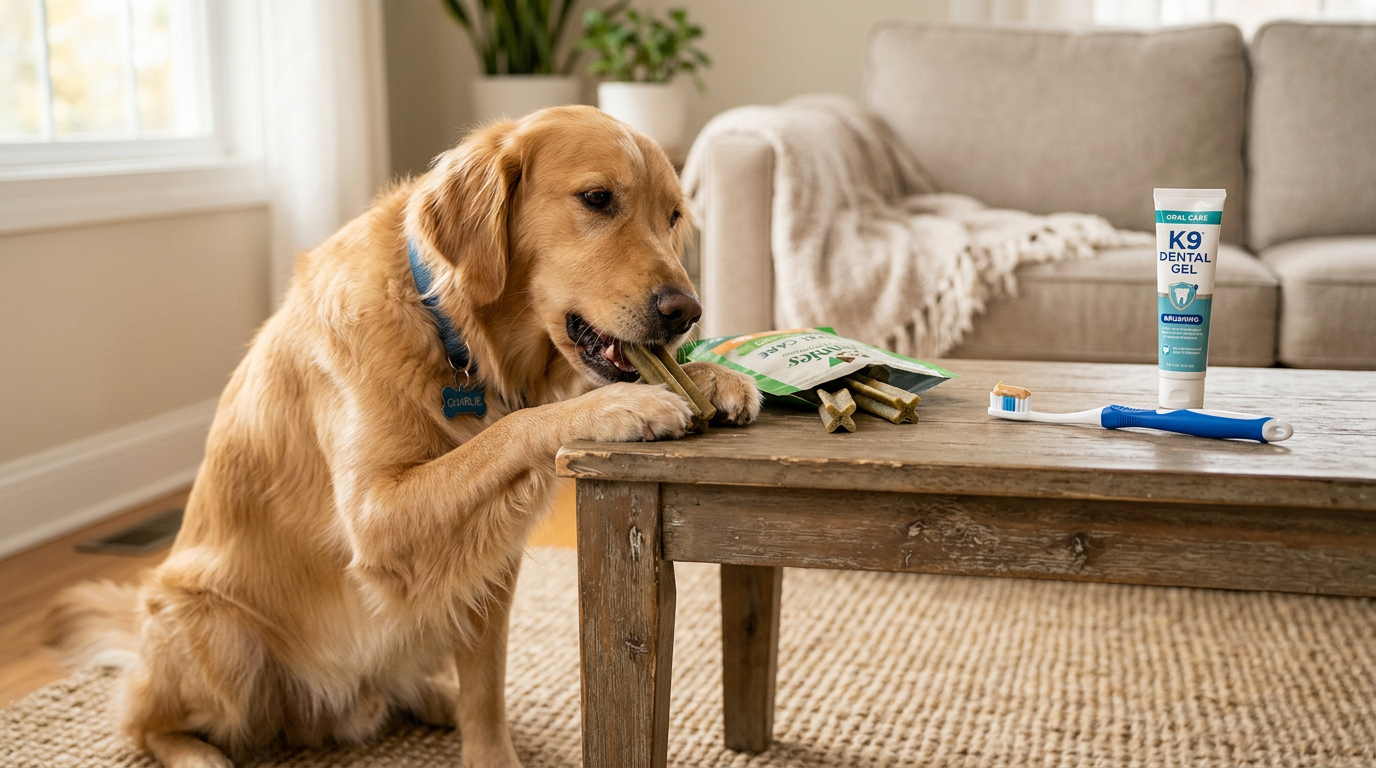
comparison • Oral Care
Dental Chews vs Brushing for Dogs: What Should You Prioritize?
Dental chews vs brushing isn’t an either/or choice. Here’s a practical, household-ready system to reduce plaque, keep breath fresher, and stay consistent long-term.
By Lucy Anderson • March 1, 2026 • 7 min read
Table of contents
- Outcome target and routine constraints
- What success looks like (measurable targets)
- Constraints that decide the plan (be honest)
- Environment design for consistency
- Station design: one place, one kit
- Cue stacking: attach it to an existing ritual
- Compliance insurance: make “partial wins” valid
- Sequence architecture: what happens first and why
- Step 1: choose the daily “primary” and the “backup”
- Step 2: build handling tolerance before you chase perfection
- Step 3: place chews where they actually help (not where they sabotage)
- Step 4: avoid “brush then immediately chew” when it creates a loophole
- Execution cadence for busy schedules
- Cadence A: the gold-standard busy routine (best results per minute)
- Cadence B: the “I will not brush daily” routine (still improves outcomes)
- Cadence C: the tolerance-build routine (for brush-averse dogs)
- Example schedules that don’t fall apart
- Product-fit matrix by household scenario
- Scenario 1: Small dog, crowded teeth, fast tartar
- Scenario 2: Large dog that gulps treats
- Scenario 3: Senior dog with sensitive gums
- Scenario 4: “My dog won’t let me brush” (behavior is the bottleneck)
- Scenario 5: Multi-pet home (dog + cat)
- Scenario 6: Weight-loss plan or pancreatitis history
- Mistakes that create regression
- Mistake 1: using chews to pay off resistance
- Mistake 2: brushing the wrong surfaces
- Mistake 3: going too long in a single session (and losing the dog)
- Mistake 4: ignoring red flags that need veterinary care
- Mistake 5: “chew stacking” (extra calories without noticing)
- 30-day implementation plan
- Days 1–3: install the system (no heroics)
- Days 4–7: start micro-brushing
- Days 8–14: expand to molars (where tartar lives)
- Days 15–21: lock in cadence
- Days 22–30: optimize and personalize
- FAQ and next-step decisions
- Should I prioritize dental chews vs brushing if I can only do one?
- Are dental chews worth it if I already brush?
- How do I choose between Greenies and Dentastix?
When pet owners ask about dental chews vs brushing, they’re usually asking a bigger question: What will I actually keep doing every week? The best oral-care plan is the one that survives real life—busy mornings, picky dogs, kids, travel, and the occasional “I forgot.”
This comparison is written like a routine you can run at home: clear outcomes, constraints, sequence, and decision rules. Brushing is still the strongest tool for daily plaque control, but dental chews can be a high-compliance “assist” that helps many households maintain momentum.
Outcome target and routine constraints
Your goal isn’t “perfect teeth.” Your goal is a repeatable system that meaningfully reduces plaque and slows tartar buildup while fitting your dog and your schedule.
What success looks like (measurable targets)
Pick 2–3 targets you can check without special tools:
- •Gums look calmer: less redness at the gumline, less “angry” swelling.
- •Breath improves: not minty-fresh, but less sour/metallic.
- •Visible plaque reduces: the back molars look less yellow/film-coated over 30 days.
- •Vet feedback improves: less tartar noted at checkups, fewer “needs a dental soon” conversations.
Constraints that decide the plan (be honest)
In the dental chews vs brushing debate, constraints decide what you prioritize week to week:
- •Dog tolerance: Will your dog allow a brush near the molars for 20–40 seconds per side?
- •Chewing safety: Does your dog gulp treats, fracture teeth on hard chews, or have GI sensitivities?
- •Calorie budget: Many dental chews add meaningful calories—this matters for small dogs and weight loss plans.
- •Household bandwidth: Are you a single caregiver? Multiple people? Kids feeding “extras”? Shift work?
Decision rule to keep you out of all-or-nothing thinking:
- •If brushing happens 4–7 days/week, prioritize brushing and use chews strategically.
- •If brushing happens 0–3 days/week, prioritize building brushing tolerance while using chews as a compliance bridge.
Environment design for consistency
Consistency is rarely a motivation problem. It’s usually an environment problem. Design the setup so the “right thing” is the easy thing.
Station design: one place, one kit
Create an “oral care station” where you already have a daily habit.
- •Best locations: next to the dog’s food bin, by the leash, or near the couch where you do evening wind-down.
- •What lives there: dog toothbrush or finger brush, dog-safe toothpaste, a towel, and a small container for dental chews.
If you have a dog who resists handling, add a non-slip mat (bath mat works) so your dog doesn’t feel unstable. Stability reduces thrashing.
Cue stacking: attach it to an existing ritual
Pick a reliable anchor:
- •After the last potty break
- •Right after dinner bowl pickup
- •During TV time (you sit, dog settles)
A good cue is something that happens even on chaotic days.
Compliance insurance: make “partial wins” valid
The fastest way to quit is to require a perfect session.
Define your minimum viable routine:
- •Minimum: 10 seconds of front-teeth brushing + one calm mouth touch.
- •Standard: 60–90 seconds total across the outside surfaces (where plaque builds most).
- •Full: standard + molar focus + brief gumline massage.
On a rough day, you still “keep the streak” with the minimum.
Sequence architecture: what happens first and why
This is where dental chews vs brushing becomes a system design question. Sequence matters because behavior and biology both have timing.
Step 1: choose the daily “primary” and the “backup”
- •Primary (best plaque disruption): brushing.
- •Backup (high compliance): dental chew.
Plaque is a soft biofilm. Brushing disrupts it directly at the gumline. Chews help by increasing chewing abrasion and saliva flow, but they’re less precise—especially right at the gum margin.
Step 2: build handling tolerance before you chase perfection
If your dog currently hates brushing, start with a 7-day tolerance ramp:
- •Day 1–2: touch cheek + lift lip + treat.
- •Day 3–4: rub teeth with a finger + treat.
- •Day 5–7: introduce toothbrush for 5–10 seconds + treat.
Keep sessions short enough that your dog ends calm. You’re building a cooperative routine, not winning a wrestling match.
Concrete example:
- •A 2-year-old rescue mix that snaps when you approach the mouth: start with lip lifts during cuddle time, then a finger brush, then the toothbrush. Use a dental chew on days you only manage handling practice.
Step 3: place chews where they actually help (not where they sabotage)
Dental chews are most useful when they:
- •replace random treats (not add on top of them),
- •happen at a consistent time (so you remember),
- •are supervised (to reduce gulping/choking risk).
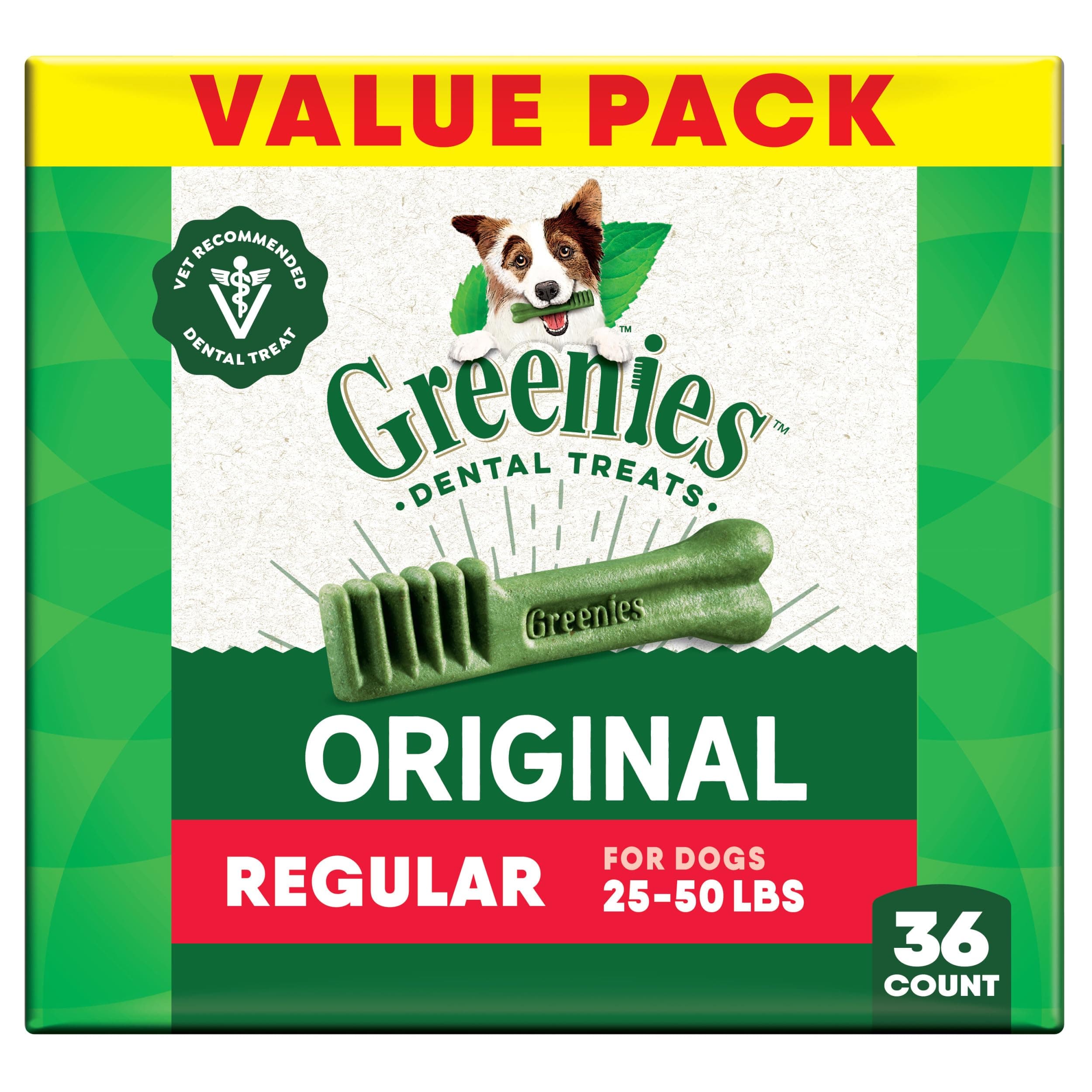
If you want a recognizable, widely used option, you can integrate chews like Greenies Veterinarian-Recommended Adult Natural Dental Dog Treats Regular Size, Dog Dental Chews, Original Flavor, 36 oz. Pack, 36 Count as a scheduled “after dinner” item—only if it fits your dog’s calorie budget and chewing style.
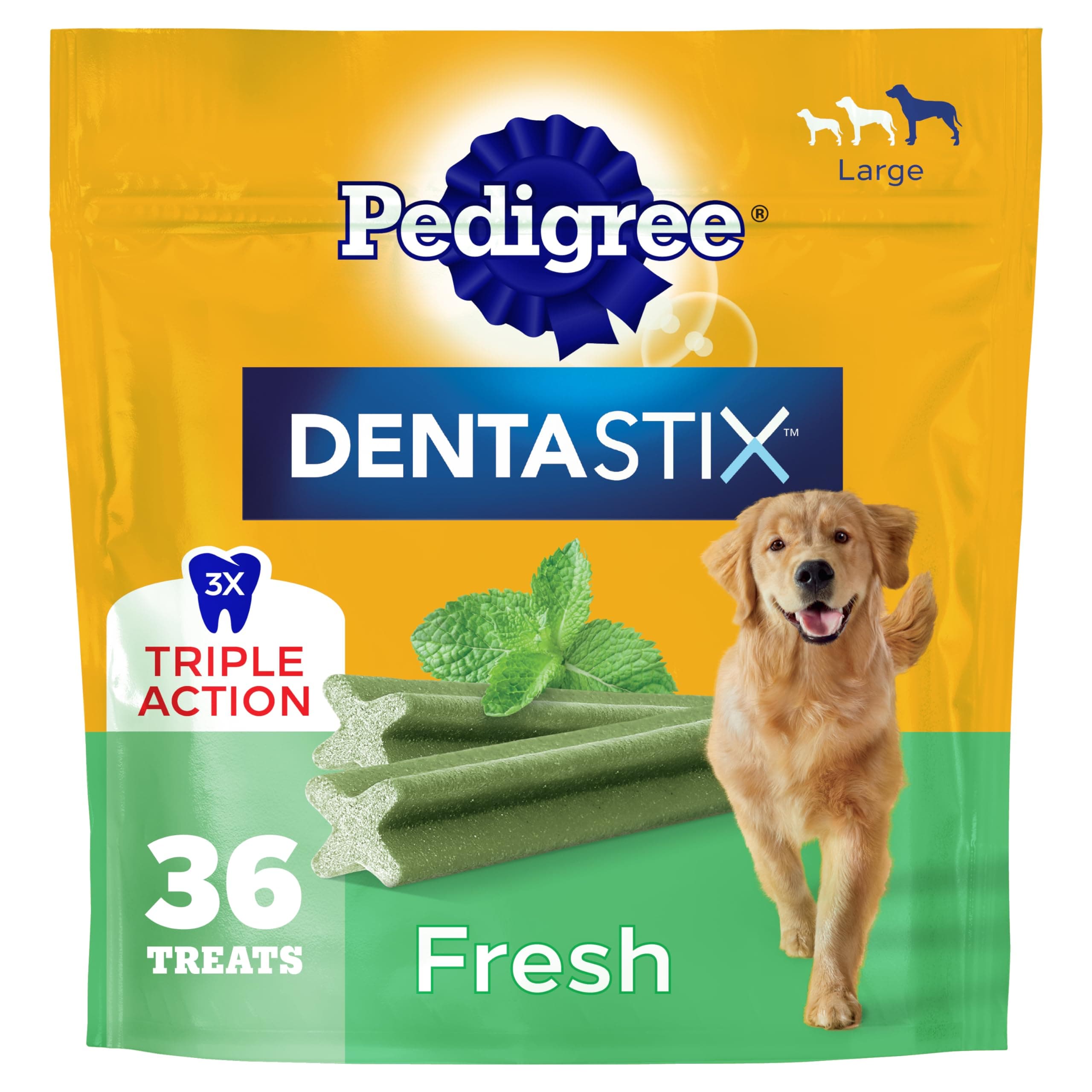
For large-breed households that want a predictable daily chew, options like Pedigree Dentastix Dog Dental Treats, Large Breed Dog Treats, Fresh Flavor, 1.87 lb. Bag (36 Treats Total) can work well as a routine cue (again: supervision and portion control matter).
Step 4: avoid “brush then immediately chew” when it creates a loophole
Some dogs learn: “If I resist brushing, I still get the chew.” If your dog is clever (many are), separate rewards:
- •Reward brushing with a tiny training treat (pea-sized) or praise.
- •Keep the dental chew as a scheduled event, not a bargaining chip.
This keeps the brushing habit from being negotiated every night.
Execution cadence for busy schedules
Your schedule determines what you can sustain. Here are cadences that work for real households.
Cadence A: the gold-standard busy routine (best results per minute)
- •Brushing: 5–6 days/week (60–90 seconds).
- •Dental chew: 2–4 days/week (on your most chaotic days or as a replacement for other treats).
Why it works: brushing does the heavy lifting; chews help on high-friction days without replacing brushing.
Cadence B: the “I will not brush daily” routine (still improves outcomes)
- •Brushing: 3–4 days/week.
- •Dental chew: 4–6 days/week.
This is the most realistic entry point for many families. It’s not perfect, but it’s far better than “chews only sometimes.”
Cadence C: the tolerance-build routine (for brush-averse dogs)
- •Handling practice: daily (30–60 seconds).
- •Brushing: 1–2 days/week initially, increasing as tolerance improves.
- •Dental chew: 5–7 days/week temporarily.
After 2–4 weeks, the goal is to shift more days toward brushing.
Example schedules that don’t fall apart
- •Two working adults: brushing on Mon/Wed/Fri/Sun; chews Tue/Thu/Sat.
- •Single caregiver with kids: brushing during one child’s bedtime story (dog on mat); chew after dinner only on nights you truly can’t brush.
- •Frequent travel: keep a travel brush + toothpaste in the toiletry kit; chews are the “hotel routine” for nights you’re exhausted.
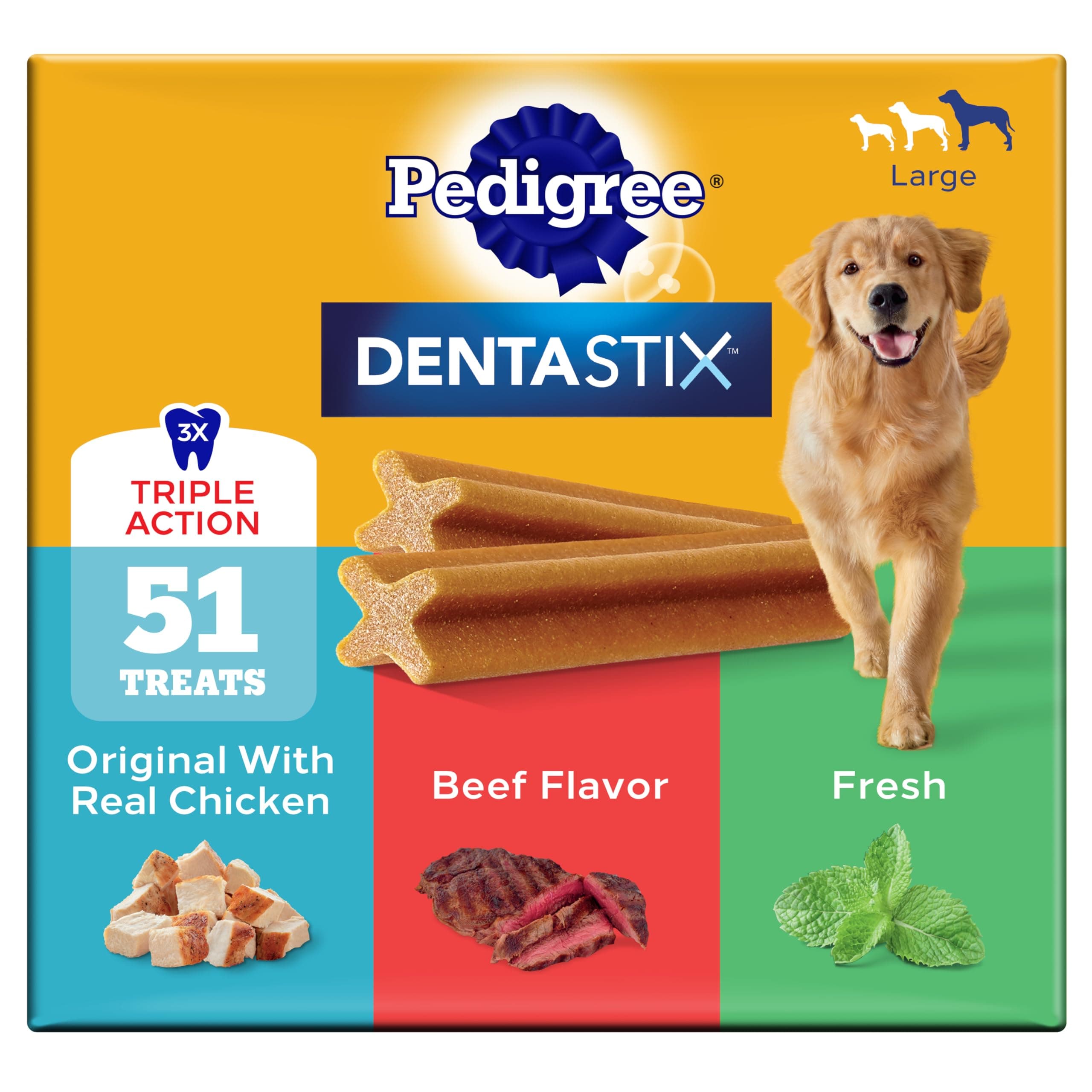
If you want variety for a large dog (and fewer “my dog is bored” battles), a rotation like Pedigree Dentastix Large Dog Treats, Original, Beef & Fresh, 2.73 lb. Variety Pack (51 Treats Total) can make compliance easier—just track calories so variety doesn’t turn into overfeeding.
Product-fit matrix by household scenario
Use this as a decision tool, not a blanket recommendation. The best choice depends on your dog’s mouth, habits, and health.
Scenario 1: Small dog, crowded teeth, fast tartar
- •Prioritize: brushing (crowding traps plaque at the gumline).
- •Use chews: carefully, calorie-aware; consider breaking a chew if label allows, or use smaller formats.
- •Watch-outs: weight gain and skipped brushing (small dogs often need brushing most).
Scenario 2: Large dog that gulps treats
- •Prioritize: brushing + supervised chew time only.
- •Chew rule: if your dog swallows big chunks, dental chews can become a GI risk or choking risk.
- •Household move: hold one end briefly at first (if safe) to encourage slower chewing, or choose a size/shape that discourages gulping.
Scenario 3: Senior dog with sensitive gums
- •Prioritize: gentle brushing and a vet check if there’s bleeding, bad breath, or visible gum recession.
- •Chews: only if your dog tolerates them well; avoid anything that seems to make your dog chew one-sided or wince.
Scenario 4: “My dog won’t let me brush” (behavior is the bottleneck)
- •Prioritize: tolerance training (daily) + short brushing windows.
- •Chews: use as a bridge, not a permanent replacement.
- •Metric: if you can go from 0 seconds to 20 seconds calmly, you’re winning.
Scenario 5: Multi-pet home (dog + cat)
If you’re running a household routine, design it per species.
- •Dog: brushing/chews as planned.
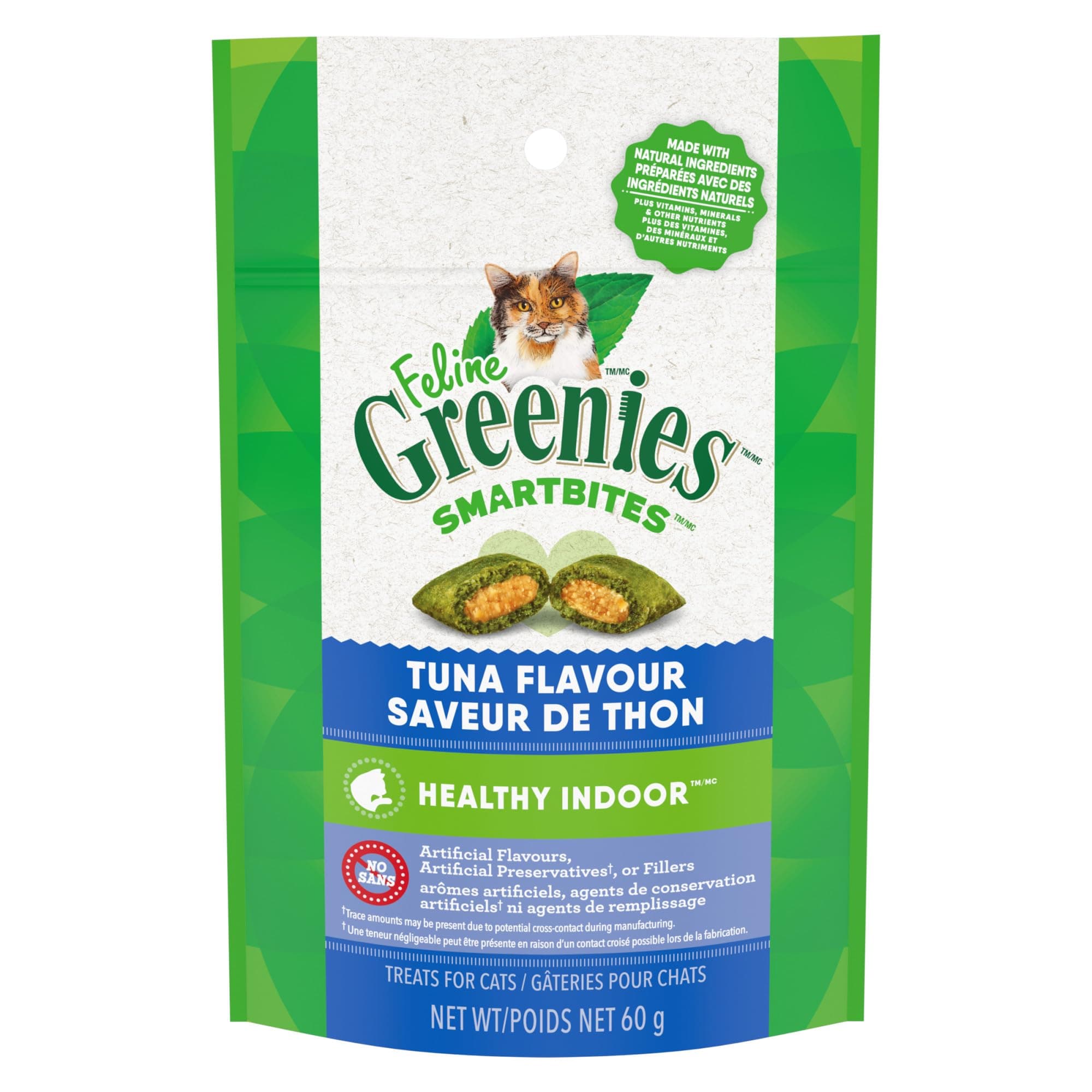
- •Cat: don’t assume dog dental chews translate. If you use treats for routine cues, keep cat products separate—something like Greenies Feline Smartbites, Cat Treats Healthy Recipe, Indoor Cat Treats, Tuna Flavor, 2.1 oz. Pack can be a “station cue” for the cat while you brush the dog, but it’s not a substitute for cat-specific dental care.
Scenario 6: Weight-loss plan or pancreatitis history
- •Prioritize: brushing.
- •Chews: only with vet guidance; calories and fat content may matter a lot.
- •System hack: make brushing the “treat” (praise + play) to avoid food rewards.
Mistakes that create regression
Most oral-care routines fail in predictable ways. Avoid these and you keep progress.
Mistake 1: using chews to pay off resistance
If your dog learns “fight the brush = get the chew,” brushing gets harder over time. Keep chews scheduled, not negotiated.
Mistake 2: brushing the wrong surfaces
The high-impact area is typically the outer surfaces, especially the back teeth (molars/premolars). If you only brush the front teeth, breath might improve a bit, but tartar still builds where it counts.
Practical technique: lift the lip, angle bristles toward the gumline, small circles, 10–15 seconds per side, then move back.
Mistake 3: going too long in a single session (and losing the dog)
A calm 45-second session you can repeat beats a 3-minute battle that makes tomorrow impossible.
Mistake 4: ignoring red flags that need veterinary care
No amount of dental chews vs brushing can fix advanced disease. Ask your vet if you see:
- •bleeding gums that persist,
- •broken teeth, facial swelling, drooling, pawing at mouth,
- •sudden refusal to chew,
- •breath that smells rotten even after you improve home care.
Mistake 5: “chew stacking” (extra calories without noticing)
If a dental chew becomes in addition to training treats, table scraps, and enrichment, weight gain sneaks up. Decide what the chew replaces.
30-day implementation plan
This plan assumes you want a sustainable routine, not a perfection sprint. Adjust for your dog’s temperament.
Days 1–3: install the system (no heroics)
- •Pick your anchor time (after dinner or last potty break).
- •Build the oral-care station.
- •Do 30 seconds of handling practice daily (lip lift + touch).
- •Give dental chews only on schedule (not as a bribe).
Success metric: your dog stays relaxed during mouth contact.
Days 4–7: start micro-brushing
- •Brush 10–20 seconds on outer front teeth.
- •Keep it calm; stop before the dog gets frustrated.
- •Use a chew on 3–5 days this week if brushing is still short.
Success metric: your dog accepts the toothbrush entering the mouth zone.
Days 8–14: expand to molars (where tartar lives)
- •Brush 30–60 seconds total.
- •Spend at least 10–15 seconds per side on the back teeth.
- •Reduce chews if they’re pushing calories too high; increase brushing days instead.
Success metric: you can reach the back teeth briefly without a struggle.
Days 15–21: lock in cadence
Pick one of these and commit for a week:
- •5 brush days + 2 chew days, or
- •4 brush days + 3 chew days.
Success metric: you don’t miss two days in a row.
Days 22–30: optimize and personalize
- •Identify the failure point (time, dog resistance, forgetfulness, multi-person inconsistency).
- •Fix one lever:
- •If you forget: set a phone reminder tied to the anchor.
- •If the dog resists: shorten sessions and increase frequency.
- •If multiple people feed treats: assign chew days on a calendar.
End-of-month check: compare breath, gum color, and visible plaque to Day 1. If you see no improvement and your dog has significant tartar already, schedule a vet dental discussion—home care may need a professional reset.
FAQ and next-step decisions
Should I prioritize dental chews vs brushing if I can only do one?
If you can truly do only one, prioritize brushing because it disrupts plaque directly at the gumline. If brushing is currently impossible, use dental chews as a temporary bridge while you train tolerance.
Next-step decision: If you’re brushing fewer than 3 days/week, your first “upgrade” is not a different chew—it’s improving brushing compliance by 1–2 days/week.
Are dental chews worth it if I already brush?
Often, yes—if they replace other treats and your dog chews safely. Chews can help on nights you’re stretched thin and can add a small boost to mechanical cleaning. For many households, a scheduled chew helps maintain the habit loop (“after dinner = oral care happens”).
Next-step decision: If your dog is gaining weight or gulping, cut chew frequency and keep brushing as the core.
How do I choose between Greenies and Dentastix?
Choose based on your dog’s size, chewing behavior, calorie needs, and what your household will give consistently.
- •If you want a widely used daily chew to anchor a routine, Greenies Veterinarian-Recommended Adult Natural Dental Dog Treats Regular Size, Dog Dental Chews, Original Flavor, 36 oz. Pack, 36 Count is a common pick for routine consistency.
- •For large-breed households that want a straightforward daily chew, Pedigree Dentastix Dog Dental Treats, Large Breed Dog Treats, Fresh Flavor, 1.87 lb. Bag (36 Treats Total) can be an easy “one per day” system component.
- •If your dog gets bored and you want to reduce skipped days, rotating flavors with Pedigree Dentastix Large Dog Treats, Original, Beef & Fresh, 2.73 lb. Variety Pack (51 Treats Total) may improve adherence—just track calories so variety doesn’t become excess.
Next-step decision: If your dog gulps or has a history of GI upset, prioritize brushing and ask your vet what chew types (if any) are appropriate.
If you want, tell me your dog’s age, breed/size, current tartar level (none/mild/moderate/heavy), and whether they tolerate mouth handling—I can map you to a specific cadence and “minimum viable” brushing routine for your household.
Roundups Cluster
More in this topic

guide
Pet Feeding Station Setup: The Perfect Spot for Stress-Free Meals
guide
Best Indestructible Dog Toys for Aggressive Chewers
guide
10 DIY Cat Enrichment Ideas to Keep Your Cat Happy
guide
Positive Reinforcement Dog Training: A Complete Beginner's Guide
guide
Crate Training Puppy Schedule: Day-by-Day Plan for Success
guide
Leash Training Tips for Dogs: Stop Pulling and Enjoy Walks
Frequently asked questions
If I can only do one, dental chews or brushing?
Prioritize brushing whenever possible because it disrupts plaque directly at the gumline. If brushing isn’t currently doable, use a dental chew as a temporary bridge while you train handling tolerance, then shift more days toward brushing.
How often should I give dental chews if I’m also brushing?
A practical cadence is brushing 5–6 days per week and using chews 2–4 days per week, mainly on your busiest days. Keep chews scheduled (not used as a bribe) and make sure they replace other treats so calories don’t quietly creep up.
Why does my dog still have bad breath even with chews?
Chews can help, but they’re less precise than brushing at the gumline and may not reach the areas where plaque accumulates most (back molars). Persistent bad breath can also signal gum disease or a broken tooth—if breath stays foul after 2–4 weeks of consistent care, book a veterinary dental check.
